
Data Center Liquid Cooling Shifts Toward Recurring Revenue
Summary
Ecolab and Veralto say direct-to-chip cooling adds recurring coolant, monitoring and service demand, although full-system refresh timing remains unsettled.
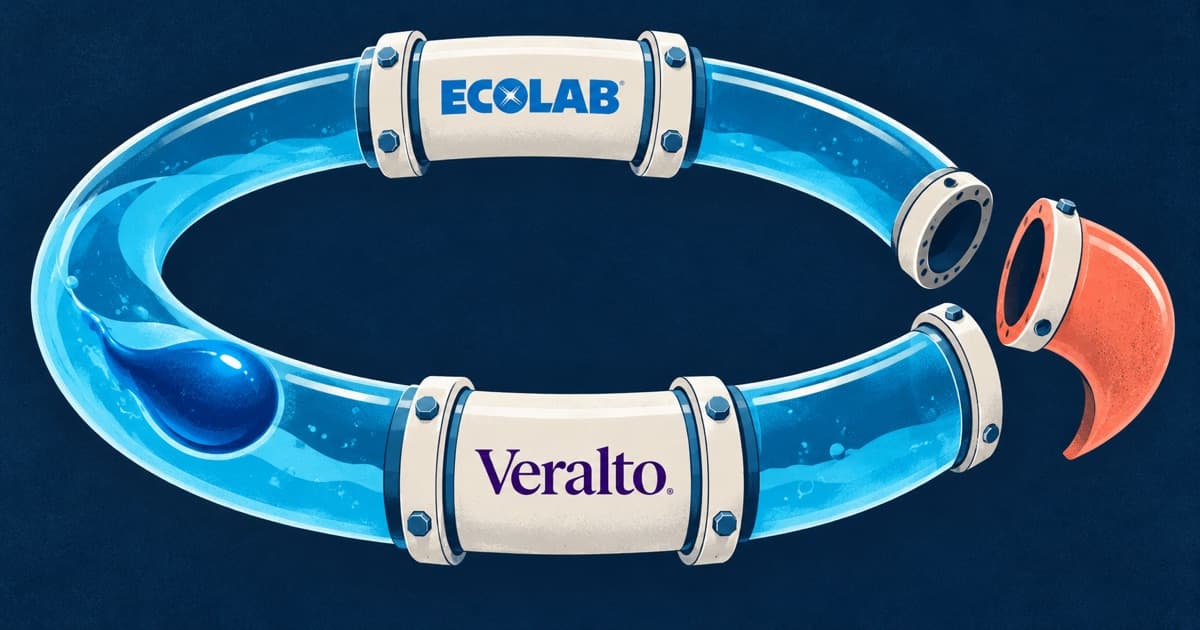
From October 27 to 30, 2026, Ecolab (ECL) and Veralto (VLTO) described direct-to-chip liquid cooling as a source of recurring coolant, monitoring and service revenue on their quarterly earnings calls. Ecolab reported 63% organic growth in its broader high-tech business, while Veralto said its data-center business doubled year over year, but the companies gave different accounts of equipment refresh timing.[1][2]
Liquid cooling extends a hardware sale into ongoing operations
Direct-to-chip liquid cooling moves coolant to cold plates near server chips to remove heat from dense computing systems. Once a system is operating, customers still need to maintain coolant purity, control corrosion and biofouling, and monitor flow and chemistry. A supplier can therefore add fluid replenishment, testing and field service to the initial sale of cold plates, controls and coolant.
Changes in chip and rack design can also require new hardware configurations. Ecolab said shorter chip generations can drive updates to cold plates, coolant, controls and coolant distribution units, and it wants to sell the package as “cooling as a service.”[1] Veralto focused more on treatment, analytics and maintenance after a data center enters service, calling the treatment side an annuity business.[2]
Both companies report growth, with different scope and scale
Ecolab's reported growth covers its broader high-tech business rather than liquid-cooling revenue alone. The company said organic sales in that business rose 63%, while management also said 63% was not the steady-state growth rate it planned around. The disclosure shows that related demand is reaching operating results, but it does not support extending one quarter's rate indefinitely.[1]
Veralto supplied a second, independent data point. It said its data-center business doubled in the third quarter of 2026 from a small base, with both treatment and analytics contributing. It also said its direct-to-chip offering combines fluid with related services.[2] Together, the disclosures support recurring operating demand, but neither provides a comparable measure of liquid-cooling revenue or profit.
“as you can think about the data center business for us, especially on the treatment side, it's an annuity business for us.”
Value may shift from components to integrated operations
The value-chain control point may move from individual hardware sales toward integrated equipment, coolant, controls, monitoring and service. Suppliers that attach service to installed systems can earn revenue outside new data-center construction, while rack-architecture changes may create redesign and replacement orders. Useful confirmation metrics include disclosed liquid-cooling revenue, service attachment, coolant consumption and design wins on new platforms.
Refresh timing remains the central boundary. Ecolab said chip generations now turn in less than a year and may require replacement of the full cooling loop. Veralto instead described a five-to-six-year technology-upgrade cycle, while Vertiv confirmed that liquid cooling is taking more of first-level heat extraction but did not corroborate full-system replacement with every chip generation.[1][2][3] Recurring fluid, monitoring and service demand is therefore better supported than annual replacement of an entire system.
Companies exposed to the change
- Dow (DOW): Dow supplies glycol for Veralto's direct-to-chip offering, giving it exposure to coolant replenishment and service, but the packet does not show that this business is already financially material.
- Vertiv (VRT): Vertiv supplies coolant distribution units and liquid-cooling systems, so rising adoption and architecture changes may affect demand, although it has not confirmed full replacement with every generation.
- Sensata (ST): Sensata's flow and protection sensors can be designed into hyperscaler cooling platforms, creating potential exposure to platform redesigns that has not yet been established as a realized benefit.
Sources
[1] Drillr · Ecolab (ECL) · 2026-10-27 · Q3 2026 earnings call
[2] Drillr · Veralto (VLTO) · 2026-10-30 · Q3 2026 earnings call
[3] Drillr · Vertiv (VRT) · 2026-10-28 · Q3 2026 earnings call
This is intended to help identify potentially overlooked industry changes and companies, not to recommend stocks.