
Lubricant Purchasing Shifts From Price to Supply Reliability
Summary
Fuchs and Quaker Houghton say the Gulf base oil shortage has made reliable delivery outrank price for lubricant buyers, bringing new customers and multi-year contracts.
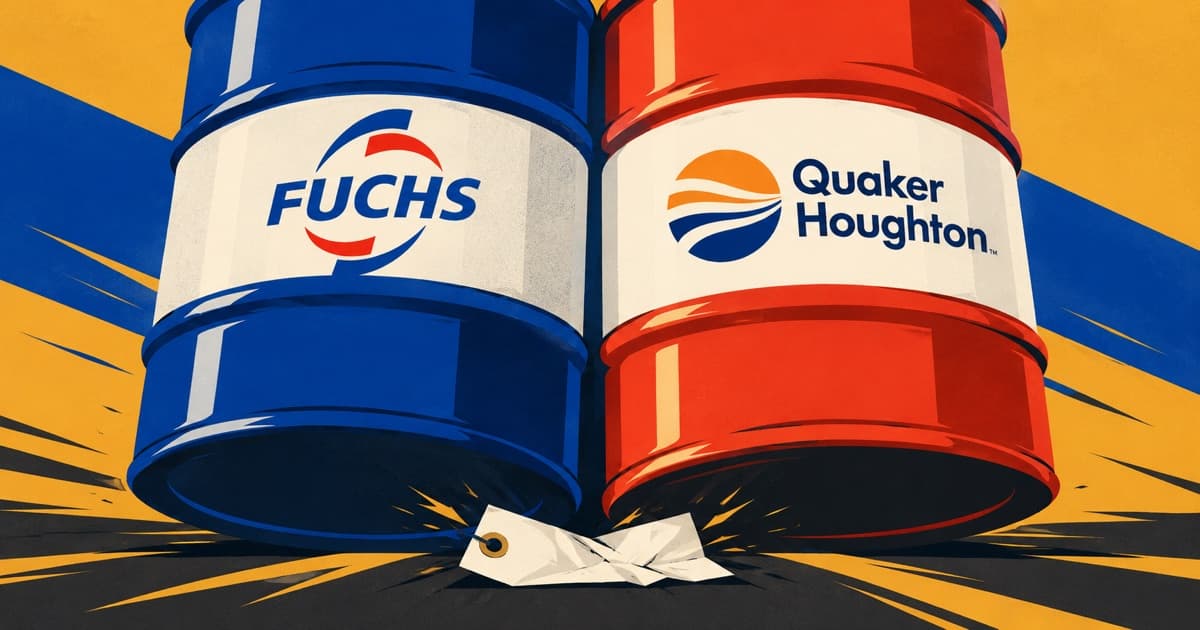
Fuchs SE (FUPBY) and Quaker Houghton (KWR) both said on their third-quarter earnings calls on October 30, 2026 that the Gulf base oil shortage has changed how lubricant customers choose suppliers: reliable delivery now matters more than price, and both companies have won new business as a result.
How the Gulf base oil shortage puts delivery ahead of price
Lubricants and metalworking fluids are blended from base oil and additives, so a blender's base oil sourcing decides whether it can ship on time. Blenders such as Fuchs and Quaker Houghton buy base oil from refiners, blend it into finished products and sell them to drivers, factories and equipment users. High-end synthetic products depend on Group III base oil (a highly refined, high-purity mineral oil) and Group IV base oil (a synthetic oil). Historically, the Middle East and the United States each supplied about half of the base oil imported by the rest of the world[1].
The Iran war has taken about a third of Middle Eastern base oil capacity fully or partially offline, which has largely disabled that export hub[1]. The Fuchs CEO said on the call that the Strait of Hormuz is probably running at about half capacity and that shipping through it is much more expensive[2]. Shell's Pearl gas-to-liquids plant in Qatar is an important source of high-end base oil; Shell said on its October 29 call that it had only partially restarted one of the plant's trains[3].
Blenders that rely on Gulf supply cannot deliver, so their customers switch suppliers or add a second one, and they accept price increases. Blenders that can move raw materials between regions pick up those orders. The Quaker Houghton CEO gave one example: the company has at times moved product from Europe to Asia to cover a local raw-material shortage[4]. As long as Gulf supply stays tight, every producer that depends on Gulf Group III and Group IV base oil faces the same customer movement.
New customers, market share and profit at two lubricant blenders
Fuchs has turned supply reliability into pricing power and long-term contracts. Its organic growth for the first nine months was EUR 359 million, or 13%, and EBIT rose 25% to a record EUR 409 million[2]. The CEO acknowledged that customers resist price increases and that the sales team is under pressure, but said availability is more important than price; new customers are normally secured with multi-year contracts[2]. The CFO said supply remains tight and that the peak in raw-material price pressure may not have arrived yet[2].
Quaker Houghton has turned supply continuity into new customers and share gains above its own target. Third-quarter sales volumes rose 3%, driven by net share gains that exceeded the high end of the company's target range, with Asia Pacific the largest contributor; price and mix contributed 7%[4]. The CEO said the company's global network kept supply running through the conflict and that this translated into new business wins[4]. The two companies sell different product lines to different customers, yet on the same day they described the same way customers are now choosing suppliers.
Share gains, not market growth, and how long contracts can hold them
Raw-material sourcing is becoming the main lever lubricant blenders use to win customers, and customers are accepting price increases and multi-year contracts to secure supply. That means multi-year contracts already signed could keep new customers in place even after the Pearl plant fully recovers. The overall market is not growing, however: additive supplier NewMarket reported an 8% decline in petroleum additive shipments in the third quarter[5], which indicates that blenders' growth is mainly share taken from competitors.
This conclusion has clear limits, and some of the share may not stick. An analyst on the Fuchs call suggested that part of the share gain may have come from competitors temporarily unable to deliver, or from customers switching to two suppliers as a precaution[2]; those customers could return once supply recovers. Quaker Houghton's net share gains have now run for 12 consecutive quarters, starting before the war, and its Middle East business is less than 3% of sales[4]. Price pass-through also accounts for a large part of both companies' growth this year. The next test is whether both companies can sustain volume and net share gains after Pearl fully restarts and traffic through the Strait recovers.
Companies exposed to this shift
- HF Sinclair (DINO): Its Petro-Canada Lubricants business makes finished lubricants and sources raw material outside the Gulf, putting it in a position similar to Fuchs to pick up orders; whether it can also convert supply reliability into long-term contracts needs to be verified with its own data.
- Calumet (CLMT): A US producer of paraffinic base oil, about half of it Group II; if blenders reformulate toward Group I and Group II because of the Group III shortage, its part of the raw-material chain could see more demand.
- Valvoline (VVV): A large lubricant buyer whose full synthetic lubricants use Group III base oil as a key input; it sits on the buyer side and is exposed to the same supply constraint and supplier screening.
Sources
[1] Drillr · Calumet (CLMT) · 2026-08-07 · Q2 earnings call
[2] Drillr · FUCHS SE (FUPBY) · 2026-10-30 · Q3 earnings call
Obviously there's always resistance against price increases and not all of our customers have such a good year as we have it and it's tough for our salespeople but we also know what we need to get and we are in constant discussion and as we said before availability is more important.
[3] Drillr · Shell (SHEL) · 2026-10-29 · Q3 earnings call
[4] Drillr · Quaker Houghton (KWR) · 2026-10-30 · Q3 earnings call
[5] Drillr · NewMarket (NEU) · 2026-10-29 · Q3 earnings call
This article is meant to help you spot industry shifts and companies that may be overlooked. It is not a stock recommendation.