
Data Center Power Equipment Moves Toward 800V Architectures
Summary
Enphase demonstrated medium-voltage-to-800V conversion, while BorgWarner shipped microgrid inverter samples to seven customers. Revenue remains unproven.
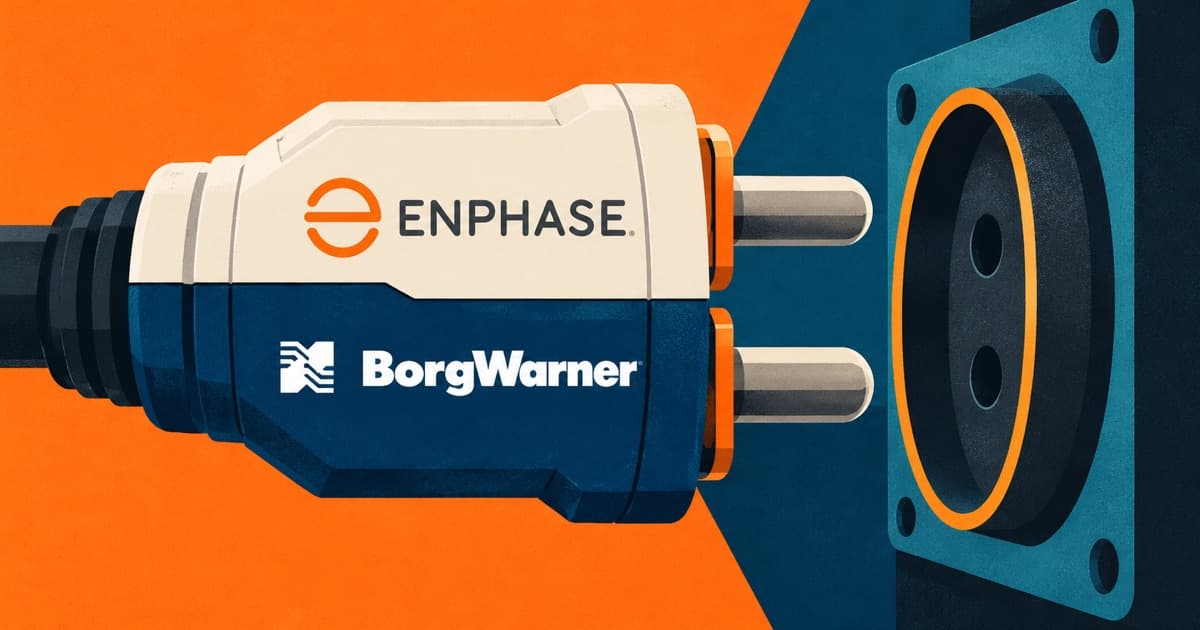
In October 2026, Enphase Energy (ENPH) and BorgWarner (BWA) disclosed in third-quarter earnings materials that they are adapting established high-voltage power-electronics platforms from solar and automotive markets for AI data centers. Enphase demonstrated a system converting 13.8-kilovolt AC to 800-volt DC, while BorgWarner shipped microgrid inverter samples to seven customers.[1][2]
Higher rack density is changing the power path
As AI server racks draw more power, the losses, equipment count, and deployment time associated with repeated AC-to-DC conversion become more costly. Conventional data centers typically move electricity through several transformation and rectification stages before it reaches a rack. An 800V DC architecture aims to remove some intermediate conversions and bring high-voltage power closer to the computing load. The key question is whether customers will redesign the full distribution system and validate its safety, reliability, and maintenance model.
Enphase's IQ solid-state transformer converts medium-voltage AC directly to 800V DC and reuses gallium nitride power modules developed for solar microinverters. BorgWarner is adapting the 800V inverter architecture and silicon and silicon-carbide capabilities used in electric vehicles for stationary microgrids. Reusing these platforms may reduce some foundational development work, but both products still require data-center-specific system qualification.
Demonstrations and samples have not yet become revenue
Both companies have moved beyond a concept, but neither has disclosed verifiable commercial revenue from the new market. Enphase said it had completed a 13.8-kilovolt demonstration and planned a 34.5-kilovolt demonstration in the fourth quarter. Its pipeline includes two global technology companies, with customer pilots targeted for 2027 and commercial shipments for 2028.[1] Management also described a potential $1 billion annual revenue opportunity by 2030, but that estimate depends on customer discussions, market size, assumed share, and pricing rather than booked orders.
BorgWarner is at the customer-sampling stage. The company said its microgrid inverters had been delivered to seven customers and received positive efficiency feedback. The design reuses an advanced-EV 800V architecture and silicon and silicon-carbide expertise.[2] Samples indicate customer interest, not a production award. Together, the disclosures show cross-industry technology transfer entering qualification; they do not establish 800V DC as the only winning standard.
Value could spread across the full power system
If customers adopt 800V architectures more broadly, incremental value could flow through conversion equipment, power semiconductors, and integrated data-center electrical systems. SolarEdge has demonstrated a medium-voltage-to-DC design for data centers and reported 99% conversion efficiency. Vertiv is validating rack-level and data-hall 800V systems with customers. Infineon supplies silicon-carbide, gallium-nitride, and silicon devices across several high-voltage AI power topologies.[3][4][5]
The boundary is important. Vertiv expects AC, rack-level 800V, and data-hall 800V designs to coexist, so the market may not converge quickly on one architecture.[4] The next useful checks are whether Enphase begins pilots in 2027, whether BorgWarner converts samples into its first commercial award, and whether customer qualification produces disclosed orders or revenue.
Companies exposed to the shift
- SolarEdge (SEDG): Its medium-voltage-to-DC demonstration follows a path similar to Enphase's, but the next question is whether the demonstration becomes customer pilots and shipments.
- Vertiv (VRT): It is validating 800V systems and integrates broader data-center power infrastructure; any upside depends on the architecture customers select and the equipment content per megawatt.
- Infineon (IFNNY): It supplies several classes of power semiconductor used in high-voltage conversion, but its AI power demand spans multiple topologies and cannot be attributed only to 800V systems.
Sources
[1] Drillr · Enphase Energy · 2026-10-27 · Q3 2026 earnings-call summary
[2] Drillr · BorgWarner · 2026-10-29 · Q3 2026 earnings-call summary
“Microgrid inverters have shipped samples to seven customers with positive efficiency feedback.”
[3] Business Wire · SolarEdge and Infineon collaboration on 800V DC AI data centers · 2026-09-09 · News release · https://www.businesswire.com/news/home/20260908612188/en/SolarEdge-Extends-Collaboration-with-Infineon-to-Enable-Solid-State-Protection-for-800-VDC-AI-Data-Centers/
[4] Drillr · Vertiv · 2026-07-29 · Q2 2026 earnings call
[5] Drillr · Infineon · 2026-08-05 · Fiscal Q3 2026 earnings call
This article identifies potentially overlooked industry changes and companies. It is not a stock recommendation.