
Old Dominion (ODFL) Q3 2026: Operating Ratio Beats Guidance on Fuel Surcharges
Summary
Old Dominion posted a 71.5% Q3 2026 operating ratio and 5.1% ex-fuel yield growth, both ahead of guidance, but fuel surcharges drove most of the profit gain.
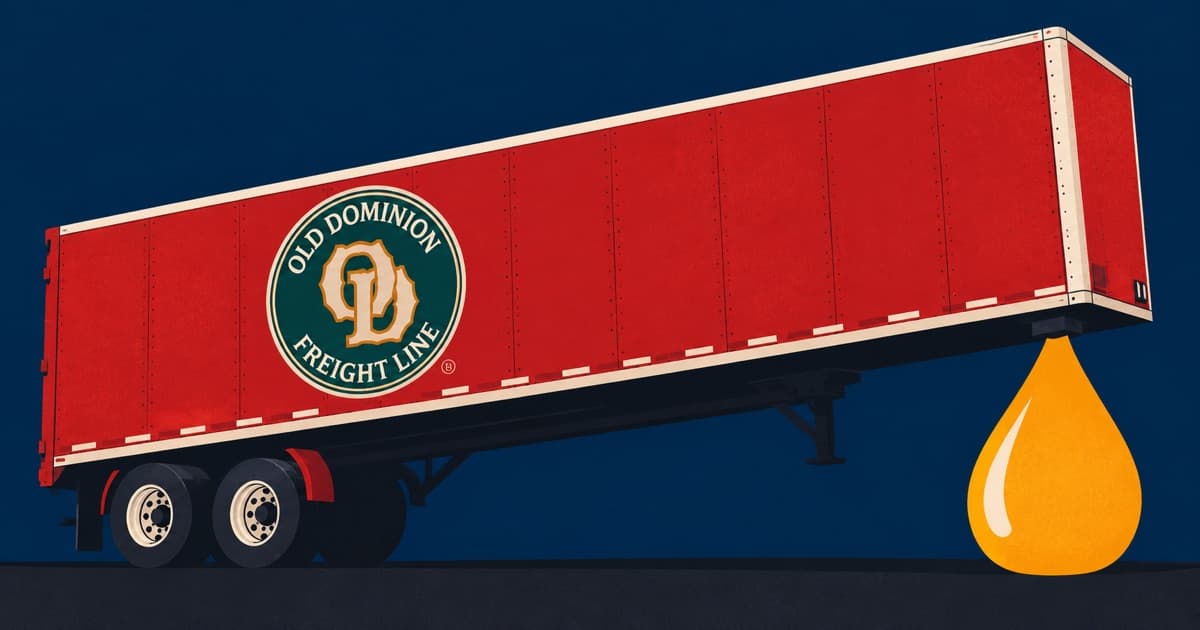
Old Dominion Freight Line (ODFL) reported third-quarter 2026 results (quarter ended September 30) on October 28, 2026, through its 8-K earnings release and earnings call. The Old Dominion Q3 2026 operating ratio and ex-fuel yield both beat company guidance, but most of the profit improvement came from fuel surcharges [1][2]. Coming into the quarter, three questions mattered: whether freight volume would stop falling, whether ex-fuel pricing could hold the operating ratio, and how much of the profit gain diesel-driven surcharges explained [3]. By a rough calculation from company operating statistics, the surcharge increase equaled about 80% of the operating income increase, and excluding fuel, cost per shipment rose faster than revenue per shipment. Volume nearly stabilized, and cash generation stayed solid.
Old Dominion is one of the highest-margin less-than-truckload (LTL) carriers in the US. It moves smaller shipments that do not fill a whole truck and ran 260 service centers at the end of 2025 [4]. Nearly all revenue comes from LTL freight charges and a fuel surcharge that resets weekly with diesel prices; the main costs are labor, diesel and depreciation [4].
Operating ratio and ex-fuel yield beat guidance
Old Dominion's third-quarter operating ratio was 71.5%, a 280-basis-point improvement from a year earlier and better than the 71.6%-72.1% the company guided to in July [1][3]. The operating ratio is operating expenses as a share of revenue. Operating income was USD 452.6 million, up 25.4%, and diluted earnings per share were USD 1.65, up 28.9% [1].
Ex-fuel pricing beat guidance by a wider margin. LTL revenue per hundredweight (per 100 pounds) excluding fuel surcharges was USD 30.25, up 5.1%, against the company's earlier expectation of 4%-4.5% [1][3]. Weight per shipment rose 1.9%, and pricing still came in above guidance [1]. October ex-fuel yield was up 5.5%-6%, which includes a timing benefit from the general rate increase taking effect one month earlier than last year [2].
Headcount control also supported margins. Average active full-time employees were 20,202, down 4.1% year over year and only 0.6% above the second quarter, while tons per day rose 1.2% sequentially [1][2]. Depreciation also fell year over year as the fleet shrank [2].
Fuel surcharges drove most of the profit improvement
Fuel surcharges were the main visible source of operating income growth this quarter. LTL revenue per hundredweight including fuel rose 13.3%, 8.2 percentage points faster than the ex-fuel figure [1]. The company does not disclose surcharge revenue; multiplying the per-hundredweight gap by hundredweight volume gives a rough estimate of about USD 125 million in additional surcharge revenue.
Fuel-related costs rose by less than surcharge revenue. Operating supplies and expenses increased USD 45.1 million (+31.3%), 2.4 times the rate of revenue growth, which management attributed to higher diesel and other petroleum-based product costs [1][2]. After also subtracting a USD 6.7 million increase in purchased transportation, about USD 73 million of the surcharge increase remains, roughly 80% of the USD 91.8 million increase in operating income [1].
Excluding fuel, pricing did not outrun cost per shipment this quarter. By a rough calculation from operating statistics, salaries, wages and benefits per shipment rose about 8.5%, ahead of the 7.1% increase in revenue per shipment excluding fuel [1]. Fringe benefits rose from 39.7% to 42.8% of salaries and wages. Management said this was about a full operating-ratio point of headwind and that cost inflation per shipment was running above the 5%-5.5% it had expected [2]. Salaries, wages and benefits fell as a share of revenue mainly because surcharges enlarged the revenue base.
Management views the surcharge as the fuel-linked part of pricing and said that, ideally, it is profit-neutral whether fuel rises or falls [2]. This quarter's figures show the surcharge increase was well above the visible fuel cost increase. If diesel falls, surcharge revenue could decline before costs do, and part of the improvement could reverse. Third-quarter diesel price per gallon and consumption will not be available until the 10-Q.
Volume nearly stabilized
Freight volume nearly stopped falling in the third quarter, driven mainly by more shipments. LTL tons per day fell 0.1% year over year, compared with a 4.1% decline in the second quarter; shipments per day fell 2.0%, compared with 5.7% [1][5]. Tons per day rose 1.6% year over year in both September and October to date, but October was weaker than normal seasonality on a sequential basis [2]. Third-quarter revenue of USD 1,590.7 million, up 13.1%, was above the company's USD 1.52-1.55 billion scenario range, and the excess came from higher revenue per hundredweight [1][3].
Conclusion
The quarter strengthened the view of Old Dominion's growth and profitability, but the profit improvement was concentrated in fuel. Excluding fuel, pricing and cost per shipment grew at roughly the same pace, and benefit cost pressure persists. Third-quarter operating cash flow was USD 469.5 million, capital expenditures were USD 67.1 million and cash at quarter end was USD 466.2 million [1]. The company expects fourth-quarter revenue of USD 1.54-1.58 billion and an operating ratio of about 73.5%, plus or minus 20 basis points [2]. The next tests are whether tons per day keep growing year over year, whether the fuel contribution persists, and whether ex-fuel pricing again outpaces costs.
Sources
[1] ODFL Q3 2026 8-K filed 2026-10-28, October 28, 2026, Old Dominion Freight Line, 8-K Exhibit 99.1 earnings release, https://www.sec.gov/Archives/edgar/data/878927/000087892726000031/odfl-ex99_1.htm [2] ODFL Q3 2026 earnings call 2026-10-28, October 28, 2026, Old Dominion Freight Line, third-quarter 2026 earnings call [3] ODFL Q2 2026 earnings call 2026-07-29, July 29, 2026, Old Dominion Freight Line, second-quarter 2026 earnings call [4] ODFL 10-K filed 2026-02-24, February 24, 2026, Old Dominion Freight Line, 2025 Form 10-K annual report [5] ODFL Q2 2026 8-K filed 2026-07-29, July 29, 2026, Old Dominion Freight Line, second-quarter 2026 earnings release (8-K)