
Data Center Power Contracting Shifts Toward Utility GenCo Structures
Summary
NiSource expects GenCo EPS of $0.32-$0.40 by 2030, while AEP and FirstEnergy assess similar structures for data center power projects.
On October 28, 2026, American Electric Power (AEP), NiSource (NI), and FirstEnergy (FE) discussed using long-term contracts or separate generation companies to supply data center power. NiSource has signed projects and quantified expected returns, while AEP and FirstEnergy still describe the structure as an option.[1][2][3]
Long-term contracts move dedicated generation outside the ordinary rate base
A regulated utility traditionally builds a power plant, adds the approved investment to its rate base, and recovers the cost plus an allowed return through customer bills. Data centers create large loads, but demand, construction schedules, and actual power use remain uncertain. Under the traditional model, existing customers could bear some risk for assets built around one large customer.
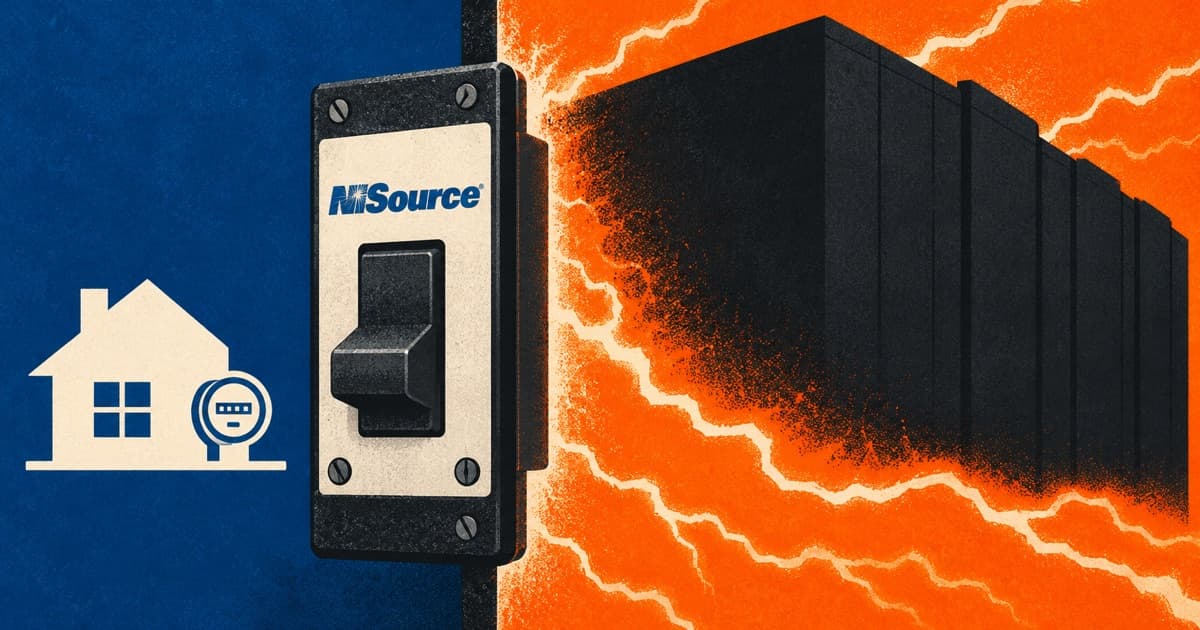
A separate generation company, or GenCo, offers another arrangement. A creditworthy data center customer first signs a long-term contract with minimum capacity payments, variable-cost pass-through, and termination protection. A utility affiliate then builds or owns the generation outside the ordinary regulated rate base and sells its output under an approved contract. NiSource explicitly said these assets are isolated from the rate base, so ordinary electric customers do not bear the construction risk.[2]
Faster review and contracted returns make the model attractive
NiSource disclosed the most concrete terms. It plans to file a special contract by the end of 2026 and seek approval in the first half of 2027 under an expedited 90-to-120-day review framework already established for its data center agreements. The contract lets the company recover its investment and earn a return over the term.[2] NiSource expects GenCo to contribute $0.32 to $0.40 per share in 2030 and $0.52 to $0.68 by 2033.[2]
AEP and FirstEnergy remain closer to the evaluation stage. AEP placed long-term contracted infrastructure in a separate AEP Infrastructure segment and said that, if a state-level GenCo path becomes viable, part of its plan or future gas plants in West Virginia and Indiana could use that vehicle.[1] FirstEnergy said GenCo remains under consideration as a way to serve new large loads while protecting existing customers. It previously said the structure would require federal wholesale approval and state approval of the power purchase agreement, but could move faster than the traditional plant-certification process.[3][4]
The control point shifts from broad rate recovery to customer contracts
This structure makes the large customer's credit and contractual protection more important to whether a project can proceed, rather than relying only on cost recovery across all utility customers. Utilities may gain contracted returns and a shorter approval route. Equipment suppliers, however, benefit from the underlying generation build, not from the GenCo legal form itself. Gas turbines, fuel cells, batteries, and grid equipment could receive orders as projects advance, but the research does not show that supplier economics depend on the ownership vehicle.
The model is not yet an industry standard. NiSource has implemented it and quantified expected earnings, while FirstEnergy is still evaluating it and AEP has not committed future gas plants to a GenCo. Southern Company continues to describe company-owned generation moving through regulated requests for proposals and commission approval. Investors should track special-contract approvals, final investment decisions from AEP and FirstEnergy, and the rate at which load requests become equipment orders.
Companies exposed to the buildout
- GE Vernova (GEV): Its Power segment supplies gas turbines, while AEP and FirstEnergy are evaluating large gas-generation projects. The company is exposed to new generation construction, but the evidence does not show that the GenCo structure itself improves project economics.[5]
- Bloom Energy (BE): The company supplies modular on-site fuel cells, and FirstEnergy identified reusable fuel cells as bridge power before permanent generation arrives. Any demand still depends on project approval and customer commitments.[6]
Sources
[1] Drillr · American Electric Power · 2026-10-28 · Q3 2026 earnings call
[2] Drillr · NiSource · 2026-10-28 · Q3 2026 earnings call
[3] Drillr · FirstEnergy · 2026-10-28 · Q3 2026 earnings call
The GENCO is absolutely still on the table and we look at that as an opportunity to protect existing customers yet still serve the new large load customers.
[4] Drillr · FirstEnergy · 2026-07-29 · Q2 2026 earnings call
[5] Drillr · GE Vernova · 2026-10-28 · Q3 2026 earnings call
[6] Drillr · Bloom Energy · 2026-07-28 · Q2 2026 earnings call
This article highlights potentially overlooked industry changes and companies. It is not a stock recommendation.