
Specialty Chemicals Face Structural Sulfur Cost Reset
Summary
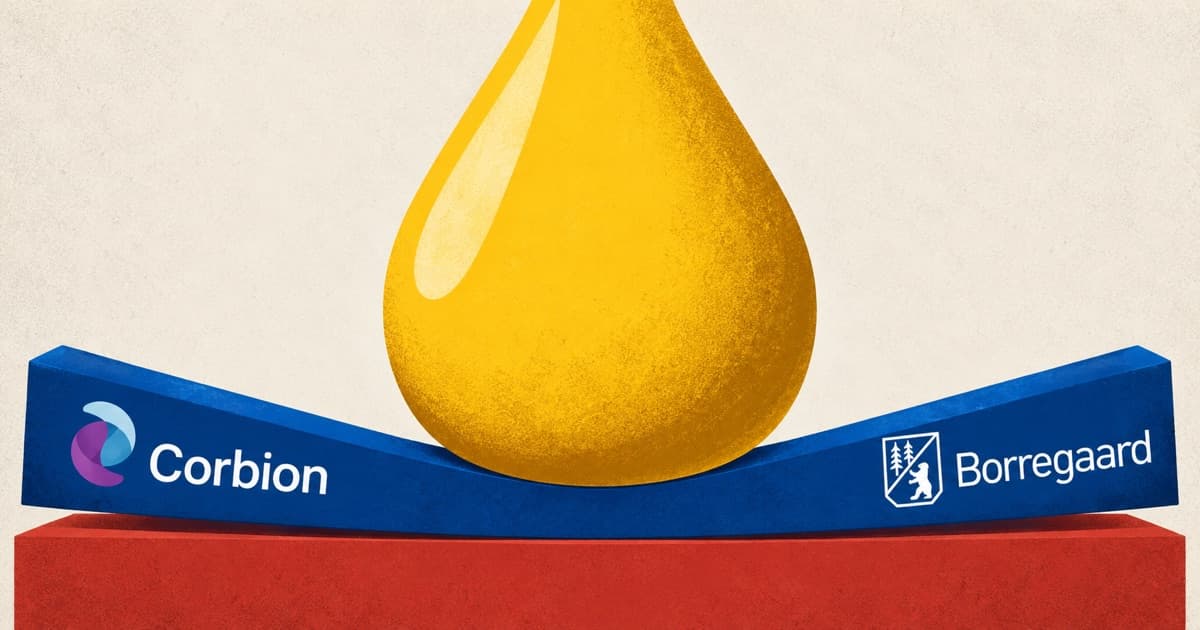
Corbion estimates a roughly 26 million annualized sulfuric-acid impact, while Borregaard weighs surcharges as sulfur costs rise across chemical chains.
On October 28, 2026, Corbion (CSNVY) and Borregaard (BRGAY) both discussed higher sulfur or sulfuric-acid costs tied to Middle East conflict. Corbion estimated an annualized impact of roughly 26 million, while Borregaard included sulfur in a NOK 40 million to NOK 60 million net cost increase versus the first quarter of 2025.[1][2]
Refinery disruption carries the sulfur shock into chemicals
Sulfuric acid is both a chemical feedstock and an essential input in many production processes. Refineries recover elemental sulfur while removing sulfur from crude oil, and downstream plants convert it into sulfuric acid. When Middle East refinery output and Gulf logistics are disrupted, sulfur and sulfuric acid become more expensive for chemical producers in Europe and across global supply chains. Corbion's lactic-acid production, Borregaard's biorefining, and processes used for phosphates and sulfate-route titanium dioxide can all face this pressure.
The cost usually reaches producers before prices adjust. Fixed-price contracts or contracts with delayed resets make manufacturers absorb the initial increase. Companies with surcharges, permanent price increases, or formula-based pricing can pass part of it to customers. The competitive difference therefore depends not only on procurement, but also on contract speed and whether a producer makes sulfuric acid internally.
Corbion and Borregaard have moved the issue into pricing decisions
Corbion offered the clearest statement on persistence. Management called the Middle East sulfuric-acid problem structural, said it did not expect a reversal, and estimated an annualized impact of roughly 26 million. In the prior quarter, the company said sulfuric-acid prices could remain elevated through 2027 because supply depends on Middle East refinery output.[1][3]
Middle East sulfuric acid issues are structural with no expected reversal, causing ~26M annualized impact.
Borregaard grouped sulfur with higher energy and logistics costs tied to the conflict and estimated a NOK 40 million to NOK 60 million net cost increase versus the first quarter of 2025.[2] It has not announced a uniform price change, but it is discussing surcharges internally and noted that a competitor recently imposed significant surcharges.[2] The two companies use different measurement scopes, so their figures should not be added. Together, however, the disclosures show that sulfur has moved beyond routine procurement volatility and into margin and customer-pricing decisions.
Contract pass-through determines where margin pressure lands
The same sulfur shock does not produce the same outcome for every chemical company. ICL said sulfur spot prices rose more than 210% year over year while phosphate prices had only partly caught up, showing a lag between cost and selling price. Tronox said 19 to 20 Chinese sulfate-route titanium-dioxide producers curtailed output and that it converted most sulfur surcharges into permanent price increases.[4][5] AdvanSix provides another boundary: every $100 per long ton move in sulfur carries about $35 million of annual cost sensitivity, but formula and market-based pricing plus internal sulfuric-acid production can offset part of the pressure.[6]
The supportable industry conclusion is that higher sulfur costs are forcing repricing, not that every exposed company will suffer lasting damage. Investors can test the thesis by tracking whether Corbion's annualized impact declines, whether Borregaard formally adopts a surcharge, and whether phosphate and titanium-dioxide prices continue to catch up with sulfur. The research also does not identify a simple second-order beneficiary. Integrated producers may still buy elemental sulfur or consume acid elsewhere, so higher selling prices and higher feedstock costs can occur at the same time.
Companies exposed to the sulfur cost reset
- ICL (ICL): Its phosphate business consumes sulfur inputs and already faces a lag between rising sulfur costs and phosphate pricing. The margin effect depends on whether product prices continue to catch up.[4]
- Tronox (TROX): The company produces titanium dioxide, including through a sulfate-route chain exposed to the same input shock. It has used surcharges and permanent price increases, but the evidence does not establish full cost recovery.[5]
- AdvanSix (ASIX): Its integrated chemical complex has disclosed sulfur cost sensitivity, while formula pricing and internal acid production can cushion the effect. It illustrates mitigation through contracts and integration, not a confirmed benefit.[6]
Sources
[1] Drillr · Corbion · 2026-10-28 · FY2026 Q3 earnings call
[2] Drillr · Borregaard · 2026-10-28 · FY2026 Q3 earnings call
[3] Drillr · Corbion · 2026-07-31 · FY2026 Q2 earnings call
[4] Drillr · ICL · 2026-08-05 · FY2026 Q2 earnings call
[5] Drillr · Tronox · 2026-08-06 · FY2026 Q2 earnings call
[6] Drillr · AdvanSix · 2026-08-07 · FY2026 Q2 earnings call
This article highlights potentially overlooked industry changes and companies. It is not a stock recommendation.