
Chip Equipment Prices Rise on Tool Shortage
Summary
ASML raised prices on its most critical tools as 2027-28 output falls short of demand, and TSMC calls tool price inflation real while lifting 2026-28 capex.
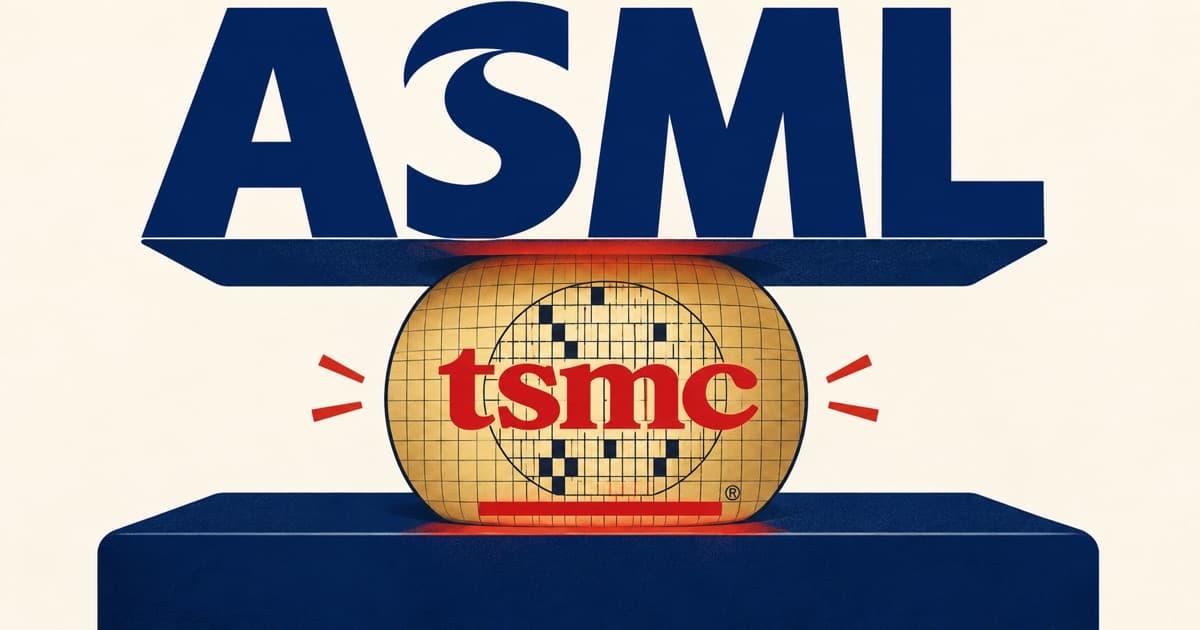
ASML (ASML) and Taiwan Semiconductor Manufacturing Company (TSM) described the same chip equipment price increase from opposite sides of the deal on their third-quarter 2026 earnings calls on October 14 and 15, 2026. Leading-edge chipmaking tools are in short supply, ASML has completed price increases on its most critical tools, and TSMC confirmed that tool prices are rising [1][2].
Why lithography tools can now be repriced
A chipmaker expanding leading-edge capacity buys tools in batches: lithography, etch, deposition and inspection. Lithography tools project circuit patterns onto silicon wafers, and Dutch company ASML makes them. In the past, ASML priced mainly on productivity. Customers paid for more wafers processed per hour, while improvements in imaging quality and overlay (how precisely one pattern layer lines up with the next) were effectively given away for free [3].
Demand for AI accelerators and high-bandwidth memory has now pushed TSMC and memory makers to add leading-edge capacity at the same time. ASML said this quarter that its currently planned output in 2027 and 2028 will not fully meet customer demand [1]. With supply behind demand, the toolmaker is in a position to renegotiate prices. ASML also said upgrade prices are closely tied to tool prices and will follow the same pattern [1], so the change reaches tools customers have already installed, not just new shipments.
Seller confirms its first price round, buyer confirms tool inflation
In July, ASML said it was entering price talks with customers. By October, its CFO said those talks were complete and had produced price increases on the most critical products, meaning the high-end tools used in high-volume manufacturing [1]. The CEO said this was nearly the first time in many years the company had held such a discussion with customers, and that customers clearly accepted that value in the ecosystem is shifting, with AI as one trigger [1]. According to the company, the increases will start to show up in revenue, average selling prices and gross margin during 2027, with the full effect from 2028 onward. ASML also said it does not plan to repeat this every year [1].
The buyer's account matches. TSMC's CFO said on October 15 that "the tool price inflation is real," alongside higher material and labor costs, but that most capex is still driven by long-term demand. TSMC expects capex from 2026 to 2028 to be significantly higher than in the past three years [2]. On its first-quarter call in April, TSMC described tools as an availability problem, with supply very tight and the company pulling in equipment as fast as it could, and did not mention price [4]. Within six months, the buyer's question moved from whether tools would arrive on time to how much more they cost.
Higher tool prices raise the cost of new capacity, but stop at system makers
When tool prices rise, a chipmaker spends more for each unit of added capacity, and a toolmaker can earn higher average selling prices and gross margins on the same unit volume [1]. During a capacity build-out, pricing power may shift toward the system suppliers whose output is tightest.
The increase has clear limits. ASML itself calls it a one-off step. Applied Materials dates its value-based pricing to post-COVID cost inflation three years ago, and Lam Research says the practice has been in place for a decade, so outside lithography, tool pricing looks more like a slow, long-running rise in gross margin [5][6]. KLA says price increases on existing products broadly track its costs, and new pricing mainly comes with new products [7]. Indicators to watch include ASML's 2027 average selling prices and gross margin, changes in upgrade pricing, and the actual growth in TSMC's 2026-2028 capex.
Companies exposed to this change
- Applied Materials (AMAT): Semiconductor equipment is about three-quarters of its revenue, and its deposition and etch tools sit in the same tool budget TSMC described. Management says it has higher pricing and margins on both new and existing products, but the company has not disclosed whether these tools will join a new round of increases alongside lithography [5].
- Lam Research (LRCX): It supplies etch and deposition tools to the same leading-edge customers. Its June-quarter gross margin rose to 52% from 49.9%, with pricing actions among the drivers, and its upgrade revenue reached a record. If the practice of upgrade prices following tool prices spreads across the industry, that revenue could be affected, but Lam has not said whether it will make similar increases [6].
Sources
[1] Drillr · ASML Holding (ASML) · 2026-10-14 · Q3 2026 earnings call
Conversations have been completed and, you know, have indeed led to pricing increases for what we call the most critical products for our customers.
[2] Drillr · Taiwan Semiconductor Manufacturing Company (TSM) · 2026-10-15 · Q3 2026 earnings call
[3] Drillr · ASML Holding (ASML) · 2026-07-15 · Q2 2026 earnings call
[4] Drillr · Taiwan Semiconductor Manufacturing Company (TSM) · 2026-04-16 · Q1 2026 earnings call
[5] Drillr · Applied Materials (AMAT) · 2026-08-13 · fiscal Q3 2026 earnings call
[6] Drillr · Lam Research (LRCX) · 2026-07-29 · June-quarter 2026 earnings call
[7] Drillr · KLA (KLAC) · 2026-07-28 · June-quarter 2026 earnings call
This article highlights industry changes and companies that may be overlooked. It is not a stock recommendation.