
Asian Telecom Carriers Shift From GPU Rental to AI Token Sales
Summary
Indosat and KT now sell AI tokens from their own GPUs to enterprises. Indosat puts hourly-equivalent GPU revenue at $15-20 versus $6-7 for rental, but token sales are not yet reported.
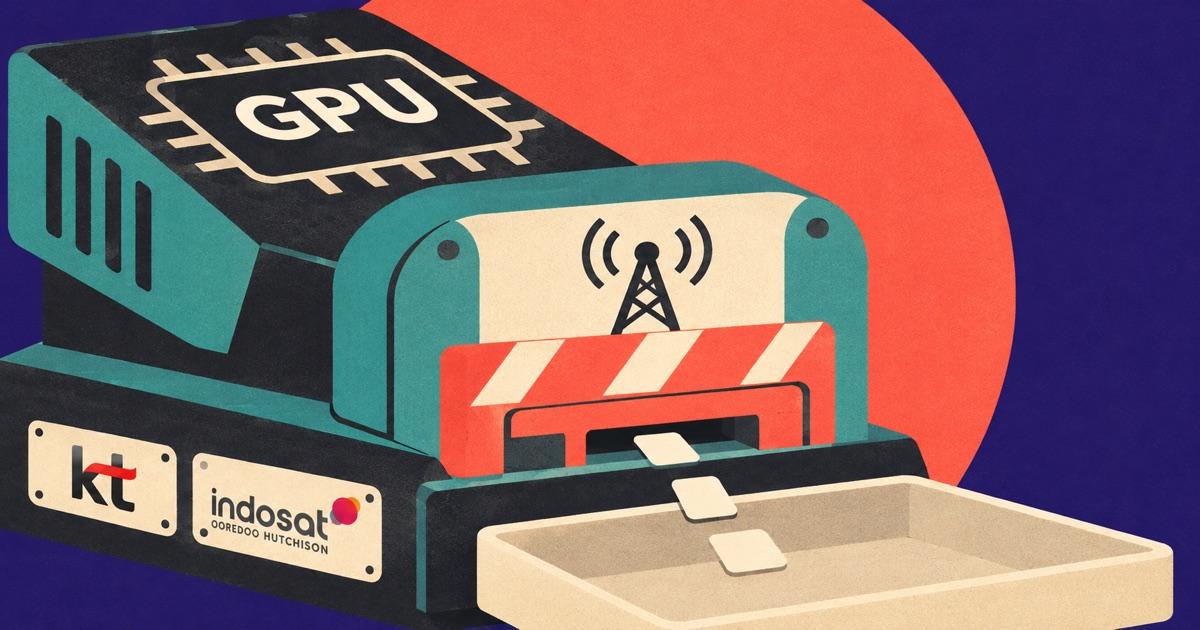
Asian telecom operators are starting to sell AI tokens instead of renting out GPU hours. On their third-quarter earnings calls between October 28 and November 10, 2026, Indonesia's PT Indosat Tbk (PTITF) and Korea's KT Corporation (KT) both described running models on their own GPUs and selling the output to enterprises by usage. Indosat estimates the switch can lift the hourly-equivalent revenue of the same GPU from $6-7 to $15-20 [1][2].
How telcos are turning GPU capacity into metered AI output
A GPU is the chip that runs AI models, and several Asian telecom operators have built domestic GPU data centers in recent years. The usual way to earn money from them is to rent GPUs by the hour, on long-term contracts, to model builders or cloud customers, so revenue depends on contract length and the hourly rate. A token is the unit a large language model uses to measure text: every question a user asks and every answer the model writes consumes a number of tokens, which makes tokens a usage meter for AI.
Indosat and KT now run open-source or partner models on their own GPUs and sell the output by token to enterprises such as banks and public institutions that need their data kept in the country. They also route customers to overseas models [1][2]. Telecom operators already bill customers by call minutes and data usage. KT said it will bring its precise telecom-grade billing into the token business [2], and Korean media report that its token charges are post-paid and added to the customer's telecom bill [3]. Any operator with domestic GPUs, enterprise customers in regulated industries and a billing system has the pieces to copy this model.
Token pricing gap and early scale at Indosat and KT
Indosat gave a price comparison for each layer of the stack. Management said long-term GPU rental earns $6-7 per hour; using the same GPU to generate and sell tokens earns up to $15-20 on an hourly-equivalent basis; and selling the output as an application bought by enterprises can reach $30 [1]. The company targets a $100 million run-rate business with a 70% EBITDA margin (earnings before interest, taxes, depreciation and amortization) by 2028, and said it had already signed enterprise customers, including banks, when its token platform launched [1].
KT launched Token Factory at the end of October. Management described two parts: locally hosted models running on KT's own GPUs, and routing of third-party models through partners such as OpenRouter [2]. KT's AX (enterprise AI transformation) revenue grew 11.9% year over year on a cumulative basis through the third quarter, and the target is more than twofold growth by 2028 from the 2025 base [2]. Both companies place the margin in tokens they generate themselves: Indosat stressed that it is not just a reseller marketplace [1], and KT called the roughly 5% commission on routing "not our main business" [3].
Margins depend on how much volume runs on telco-owned GPUs
Charging by token means a telecom operator sells model output instead of machine time, so prices can follow customer usage and data-compliance needs, which could raise the return on GPU investment. That revenue does not yet show up in reported results. KT does not break out token revenue, and only 7 of the 73 models at launch run on KT's domestic GPUs, so most early volume is low-commission routing [2][3]. On Indosat's call, an analyst also noted that GPU rental prices are rising while AI token revenue is not rising in tandem [1].
China Telecom is a further-along reference point. Its TokenHub averaged more than 1 trillion token calls a day in the first half of 2026, while its intelligence-related revenue grew only 7.1% over the same period [4]. Two metrics to track next: whether KT starts disclosing token revenue separately, and whether Indosat's token revenue approaches its $100 million run-rate target.
Companies exposed to the shift from GPU rental to token sales
- China Telecom (00728.HK): It has made token operations a main line, and its computing-network capex rose 97% in the first half. Its revenue shows how much token volume at scale actually adds to a telecom operator's total revenue [4].
- SK Telecom (SKM): It mainly rents out GPU hours today. Korean media report it has announced a token gateway on the NVIDIA AI factory it plans to complete in 2027, the same rental-to-token choice KT has just made [5].
- KDDI (9433.T): It is building an AI "factory" with its own GPUs in Sakai, Osaka, and plans to convert GPUs, data and power into computing output sold to customers. The direction is close to Indosat's and KT's, but KDDI has not described token-based pricing [6].
Sources
[1] Drillr · PT Indosat Tbk (PTITF) · 2026-10-28 · Earnings call
"when you sell GPU as a service, you sell it on a long term at $6, $7 per hour. But when you are selling token, if you have the ability to generate token and sell token, you sell it. If I put the same parallel of per hour, you can earn up to $15 to $20. And if you are able to convert that into application, if enterprise buys output, it goes as high as $30."
[2] Drillr · KT Corporation (KT) · 2026-11-10 · Earnings call
[3] The Korea Herald · KT Token Factory partnership with OpenRouter · 2026-10-27 · News report · https://www.koreaherald.com/article/10916370
[4] Gelonghui (republishing Changjiang Securities) · China Telecom H1 2026 results note · 2026-09-28 · Research report · https://m.gelonghui.com/news/5318787
[5] Metro Seoul · KT, SK Telecom and LG Uplus make AI tokens a new revenue model · 2026-11-03 · News report · https://www.metroseoul.co.kr/article/20261103500144
[6] Drillr · KDDI (9433.T) · 2026-11-06 · Earnings call
This article is meant to help surface industry changes and companies that may be overlooked. It is not a stock recommendation.