
Sprinklr (CXM) AI-Native SKU Revenue Up 40% Year Over Year
Summary
On its 2026-09-02 call Sprinklr reported over 200 customer AI engagements and 40% growth in AI-native SKU revenue, without disclosing the line's dollar size.
Sprinklr (CXM) told its 2026-09-02 earnings call that more than 200 customer AI engagements are underway and that AI-native SKU revenue grew 40% year over year. It did not give a dollar figure for that product line [1].
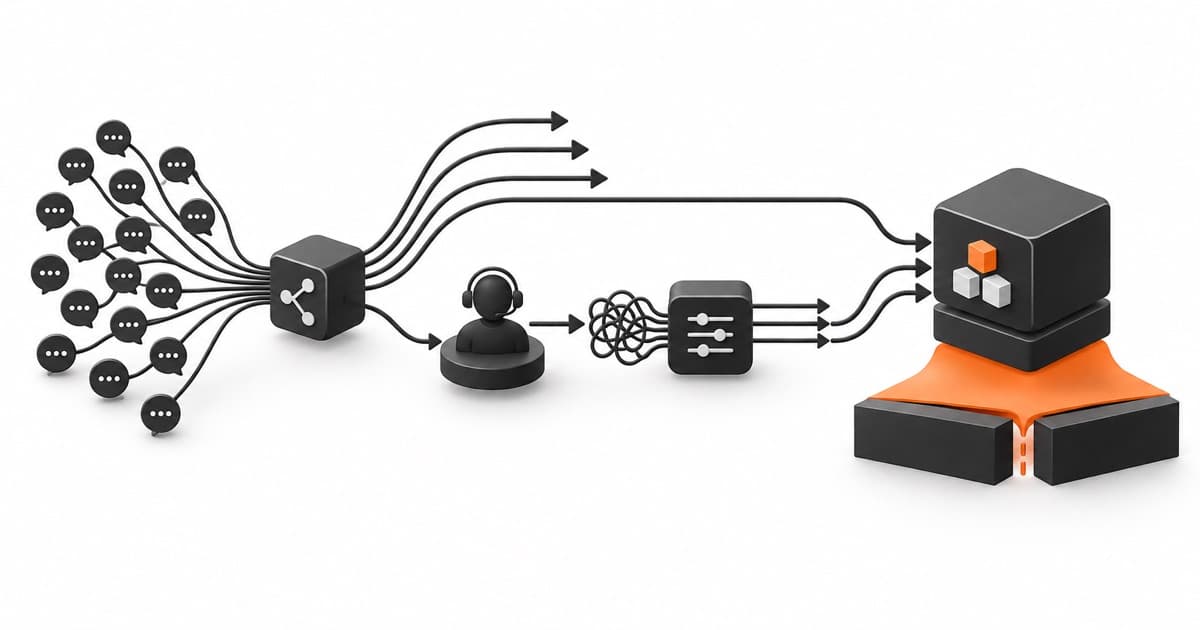
Sprinklr, Inc. (CXM) is a US enterprise software company that sells large enterprises a unified customer-engagement platform, putting social, marketing, insights and customer service in one system. Its revenue comes mainly from subscriptions and the implementation services that follow. The application discussed here sits inside the service suite and is sold to the customer-support organizations of large enterprises. It covers one stretch of work in the contact center: when a customer calls or messages with a question such as "what is my credit card balance," an automated bot recognizes the intent and answers directly instead of routing the case to a person; when a person does have to take over, the system assembles the history of that conversation for the agent, pulls the matching answer out of the knowledge base and suggests what to say next [2]. The company has called this capability Conversational AI+, Sprinklr AI Agents, agent copilot and contact center intelligence at different times. Customers buy it to cut the volume of contacts handled by people and to shorten average handling time. It runs through the company's core business rather than a side experiment.
How the contact center AI became a priced product line
The public record starts with efficiency readings measured on customers, not on Sprinklr.
On the 2023-12-06 call, a telecom customer that had enabled the chatbot saw average case handling time fall by more than 60% [2].
On 2024-09-04 that efficiency was converted into a countable volume of work: a large North American retailer raised call deflection to 35%, and the company estimated this removed 420,000 calls a year that would otherwise have needed a human agent [3].
The turn came on 2026-03-11, when AI agents, contact center intelligence and agent copilot were packaged into separately priced AI-native service SKUs. ARR for that group grew 50% year over year in fiscal 2026, the first time the company attached the capability to its own revenue reporting [4].
By 2026-06-03 the efficiency readings were being grouped by how long a deployment had been running: customers with more than six months of full agent-copilot deployment saw average handling time fall 55% [5].
The 2026-09-02 quarter uses the same basis as the previous two, at larger scale.
What the 40% does and does not measure
The latest quarter puts scale and growth rate side by side: more than 200 customer AI engagements underway and AI-native SKU revenue up 40% year over year, with management crediting agentic and contact center intelligence for the outsized growth [1].
That 40% has boundaries. It counts the AI-native SKU category as a whole, and the company has not confirmed that the category contains only contact-center functionality, nor broken out how many dollars each function contributed. It is a relative growth rate: it does not show absolute size, and it does not show what share of total revenue the line represents.
The path from customer efficiency to Sprinklr's revenue
There is a chain between the efficiency gains on the customer side and this revenue line. Bots and the agent copilot absorb part of the support conversation, the share of issues customers resolve themselves rises, human call volume and per-contact handling time fall, and customers become willing to expand the deployment and to consolidate customer-service tools previously bought from several vendors onto this one platform. The two contracts signed in the latest quarter came in that way [1].
The cost sits at the other end. The company said data and hosting costs are still rising to support its expanded AI capabilities, and it did not separate that spending from the partner cost overruns and other factors cited in the same quarter [1]. Revenue growth therefore cannot be read as an equivalent improvement in profit.
Two further limits apply. Deflection rates and handling times are gains that customers receive; they are not Sprinklr's own operating results. And the values of the two named contracts include suites beyond customer service, so they cannot be counted as revenue from this application.
What is settled and what would settle the rest
The operating change that can be confirmed is that this contact center AI has moved from efficiency anecdotes at individual customers to a revenue line that is priced on its own and has its own reported growth rate. Management also said this round of customers is getting real declines in transfer rates and real cost savings, and that proof-of-concept projects have become less common [1].
What still cannot be judged is how much it weighs. That would require the company to disclose the absolute revenue or ARR of the AI-native SKUs and their share of total revenue, together with the matching data and hosting costs. Only then does it become clear whether this product line is adding to profit or only adding scale.
Application assessment
- AI-Powered Contact Center Automation | Business position: core business | Adoption stage: limited production | Scope: company-wide | Value type: revenue growth
Sources
[1] Drillr - Sprinklr, Inc. (CXM) - 2026-09-02 - earnings call
"the error for AI native SKUs was up 40% year-over-year, and we are seeing outsized growth with our agentic and contact center intelligence."
[2] Drillr - Sprinklr, Inc. (CXM) - 2023-12-06 - earnings call
"one of our leading telecom customers using Sprinklr’s conversational AI bots and AI routing achieved over 90% improvement in the response time and more than 60% reduction in average case handling time after enabling our chatbot."
[3] Drillr - Sprinklr, Inc. (CXM) - 2024-09-04 - earnings call
"Notably, with our service suite, a large North American retailer was able to use our AI to increase their call deflection up to 35%."
[4] Drillr - Sprinklr, Inc. (CXM) - 2026-03-11 - earnings call
"In FY26, ARR from our generative AI native sprinkler service SKUs grew 50% year over year, driven by strong demand for AI agents, contact center intelligence, and agent co-pilot."
[5] Drillr - Sprinklr, Inc. (CXM) - 2026-06-03 - earnings call
"And customers with more than six months of full co-piloting deployment are seeing a 55% reduction in handling times on average, with some exceeding 70%."