
Tennant (TNC) AI Cleaning Robots: AMR Sales Up 37%, Savers Deal
Summary
Tennant's AI-navigated cleaning robots won a 250-unit Savers deployment as AMR sales reached about $31 million, up 37%. The navigation software's own contribution is not broken out.
Tennant Company (TNC) said on its August 6, 2026 earnings call that sales of its autonomous cleaning robots, including autonomy service fees, were approximately $31 million in the quarter, growing 37% year over year. Management also said Tennant was selected for a 250-robot deployment across the Savers store network. The company did not break out what the AI navigation software contributed on its own[1].
What Tennant's AI robot navigation does
Tennant Company is a US maker of floor-cleaning equipment. It designs, manufactures and sells scrubbers, sweepers and related machines to retail stores, distribution centers, factories, warehouses, schools and hospitals. Revenue comes from equipment sales and from aftermarket parts, consumables and maintenance service.
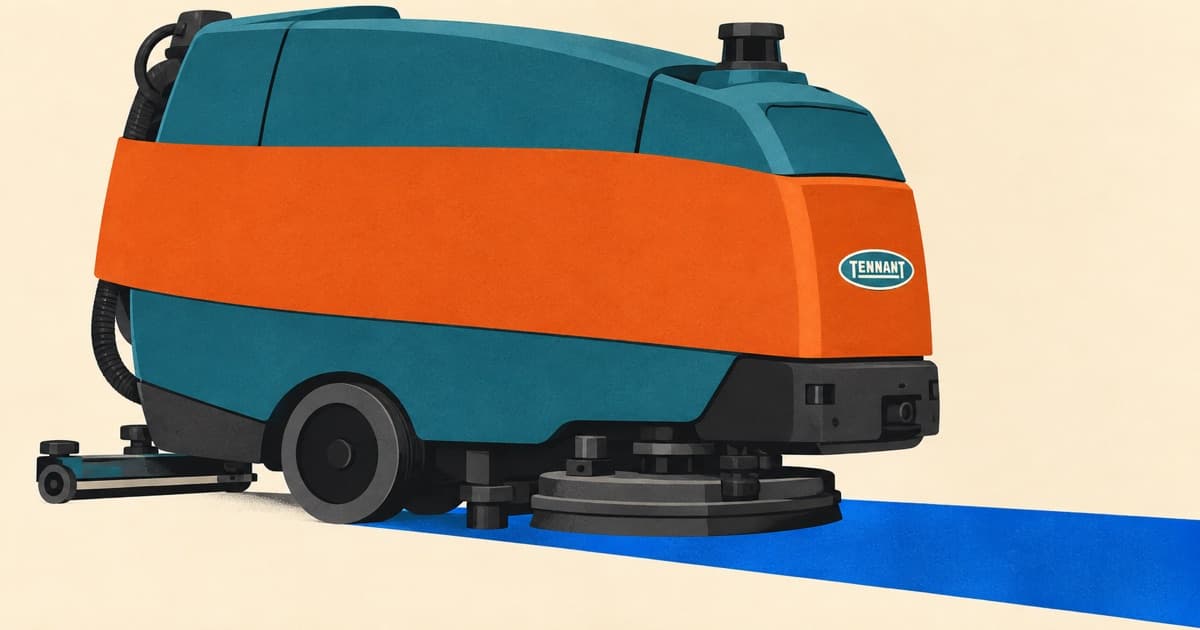
The AI application discussed here is the navigation software embedded in Tennant's autonomous cleaning robots, which the company calls AMRs (autonomous mobile robots). Exclusive partner Brain Corp supplies the software. The current generation is BrainOS Clean 2.0, and its core feature is SelfPath AI[2]. The users are the people responsible for floor cleaning in stores, warehouses and factories. The robot plans and continuously adjusts its own cleaning route, recognizes whether the obstacle ahead is a pedestrian, a crate or a forklift, and then decides whether to slow down, pause, wait or come back later. No one drives the machine during the shift[2].
Brain Corp handles the underlying AI and software. Tennant owns the customer relationship, the machine design, direct sales and service. The robots are sold as equipment plus an autonomy service fee and sit inside the company's core equipment business[2].
From a pre-launch X4 ROVR to SelfPath AI
Within the past three years of earnings calls, this application first appears on February 22, 2024. Management described the X4 ROVR, then planned for a mid-2024 launch: an autonomous cleaning robot designed from the ground up, carrying navigation software under a new exclusive technology agreement with Brain, and relying on AI chips, enhanced sensing and cameras to move through tight spaces[3]. The product had not launched, so there were no adoption or financial results.
The turning point came on the May 5, 2026 call, with the launch of BrainOS Clean 2.0 and SelfPath AI. Previously a person walked the machine through a route once and the machine repeated it. Now the machine learns the whole store by itself and keeps optimizing its routes[2]. Management said deployment time for new robots fell sharply as a result, but this was a verbal description with no baseline, sample or measurement period.
By August 6, 2026, the same navigation was listed in recent new products, including the X2 Rover robotic scrubber and the X16 industrial robotic sweeper, and the focus of disclosure had moved from product capability to customers deploying robots in volume[1].
The 250-robot Savers deployment
The latest progress comes from the customer side. Management said Tennant was selected to deploy 250 cleaning robots across the North American store network of Savers and Value Village. The deployment grew out of a small pilot, and it depended on the robots running reliably on their own, stores getting up to speed quickly and Tennant's operational support being in place[1].
Management also acknowledged that Savers is an unusually difficult setting: every store has a different layout, and the merchandise on the floor changes daily[1]. A machine taught a fixed route would need repeated retraining in that environment. Manual route training and retraining is exactly the step SelfPath AI removes[2].
The 250 figure is the number of robots in the selected deployment. The company has not disclosed how many units are installed, the contract value or the revenue recognition period, so this number cannot be converted into revenue.
What the $31 million in AMR sales does and does not show
The financial metric tied to this application is revenue: robot (AMR) sales, including equipment and autonomy service fees. Management disclosed that sales on this basis were approximately $31 million in the second quarter, growing 37% year over year[1].
A possible transmission path runs like this. Navigation capability determines whether a robot can finish cleaning a store unattended. Customers expand pilots into volume purchases on that basis, which shows up first as equipment revenue. Robots in service also pay the autonomy service fee on a recurring schedule, so service revenue accumulates with the installed base.
Only part of this can be attributed to the AI. The $31 million and 37% are bundled sales for the whole robot product line, with hardware, service and navigation mixed together. The company has not disclosed the autonomy service fee as a separate amount or the margin of the robotics business, so there is no basis yet for saying whether revenue growth turns into profit. The navigation technology is developed by Brain Corp, and Tennant uses it under an exclusive agreement. In addition, cumulative first-half growth was higher than second-quarter growth, which means the quarterly growth rate has slowed since the start of the year. The 37% should not be extrapolated as acceleration.
What is confirmed and what is still missing
What can be confirmed today is that cleaning robots carrying AI navigation have won a volume deployment from a retail customer and that robot sales are growing. SelfPath AI itself has no measured, standalone result, and there is no data on its profit contribution. In management's own words, the strategic shift is still in the early stage of execution[1]. Only if the company later reports autonomy service fee revenue or robotics gross margin separately will outsiders be able to tell whether growing robot sales mean better profit or only a change in sales mix.
Application assessment
- Autonomous Floor-Cleaning Robot Navigation | Business position: core business | Deployment stage: limited production | Scope: single business unit | Value type: revenue growth
Sources
[1] Drillr · Tennant Company (TNC) · 2026-08-06 · Earnings call
Quote: AMR sales inclusive of equipment and autonomy service fees were approximately $31 million in the quarter, growing 37% year over year.
[2] Drillr · Tennant Company (TNC) · 2026-05-05 · Earnings call
Quote: Third, the strength of this partnership was demonstrated with the launch of BrainOS Clean 2.0 and SelfPath AI. SelfPath enables advanced autonomous navigation, allowing machines to independently generate and continuously adapt cleaning routes in real time, eliminating the need for manual route training and retraining.
[3] Drillr · Tennant Company (TNC) · 2024-02-22 · Earnings call
Quote: Iterating our product and launching a purpose built ground up AMR like X4 ROVR that has improved maneuverability to navigate tight spaces, leveraging Gen3 Technology and navigation software enabled by AI chips, as well as enhanced sensing and cameras on the machine.