
Aurora (AUR): 80% of Dallas-Houston Loads Ran Without Onsite Support
Summary
Aurora said 80% of commercial loads on its Dallas-to-Houston lane needed no onsite support in Q3 2024, but the $834,000 of pilot revenue only offsets R&D expense.
Aurora Innovation (AUR) told investors on its October 30, 2024 earnings call that 80% of the commercial loads on its Dallas-to-Houston autonomous trucking lane ran the entire route without a single onsite support call [1]. Every one of those loads still ran under a safety operator's supervision, and the pilot revenue attached to them was $834,000.
What Aurora Driver actually does
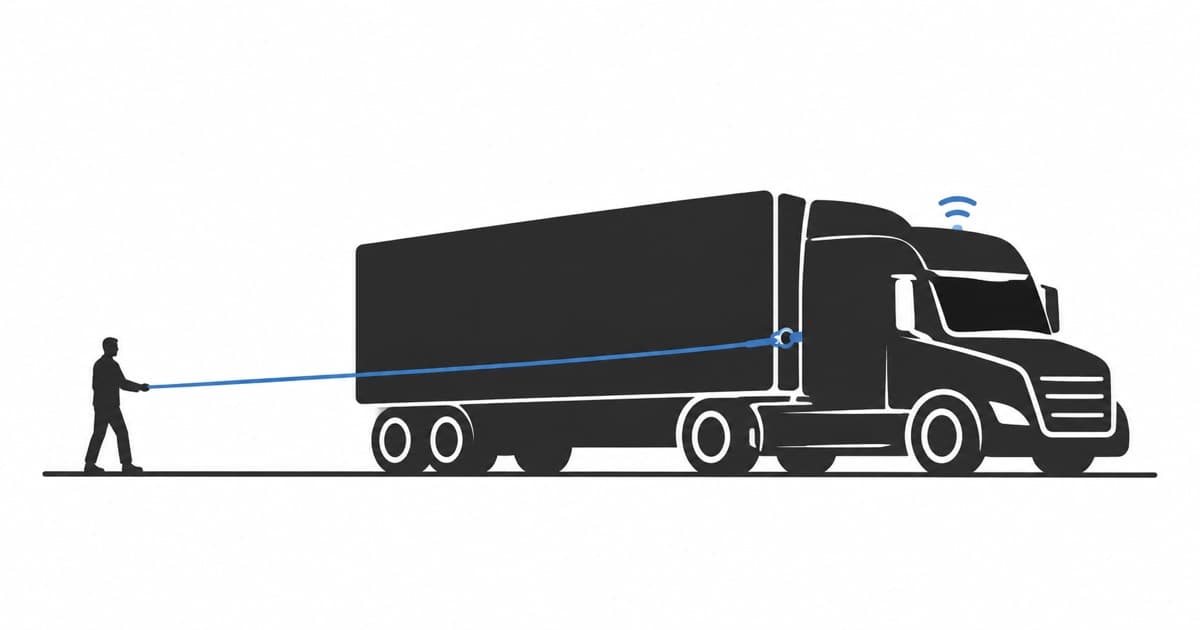
Aurora Innovation, Inc. (AUR) builds autonomous driving for heavy trucks. It does not build the trucks and it is not a carrier: the trucks come from manufacturers such as PACCAR and Volvo, and Aurora installs an AI system called Aurora Driver into them, then charges freight customers a per-mile fee to use it. Aurora Driver combines onboard lidar, radar and cameras with autonomous driving software. It is responsible for seeing the vehicles, pedestrians and obstacles on the road, controlling the truck, and moving freight along a fixed lane to its destination. Road conditions the system cannot handle are passed to remote support staff or to personnel dispatched to the vehicle. The customers using it are shippers and transport companies such as FedEx, Werner, Schneider and Uber Freight [1], and the freight moved is their commercial cargo. The system sits at the center of Aurora's business: it is the product the company currently offers.
Two calls on the same lane: 75% to 80%
The progress between the two earnings calls has a clean reading. On the first-quarter call of May 8, 2024, Aurora said 75% of commercial loads on this lane had gone the whole way without ever calling for onsite support, 13 percentage points better than the prior quarter, with a cumulative 5,450 loads delivered under safety-operator supervision and roughly 120 loads scheduled per week [2]. By the third-quarter call of October 30, 2024, that share on the same lane had risen to 80%, cumulative deliveries had passed 8,200 loads, and weekly scheduling was close to 160 loads [1]. Across that stretch the system's name, its customers and the work it performs did not change. What changed was the scale of operation and the state of pre-launch validation. By the company's own account, commercial operation without a safety operator would not begin until April 2025.
What the 80% does and does not cover
The 80% figure means that eight in ten commercial loads on this lane went from start to finish without an onsite support call, while the remaining two still needed someone to come to the truck. The quarter-over-quarter improvement was only 5 percentage points, against 13 points half a year earlier: the closer the number gets to the level where the safety operator can be removed, the slower it improves. The company has also said the share will not reach 100%, because situations like a tire blowout always require someone on site. Over the same period, on-time performance for pilot customers stayed close to 100%, which indicates service quality did not give way as the load count doubled. The measurement scope matters too: 80% is a reading for this one lane only, and as of October every load was still completed under safety-operator supervision.
Volume is the only link that touches the financials
Volume is the single point in this chain that connects directly to the financial statements. A higher intervention-free share lets Aurora schedule more loads per week on a steady basis, and commercial volume more than doubled year over year. The matching third-quarter pilot revenue was $834,000, up 75% from a year earlier. That money, however, is booked as an offset to research and development expense. It shows up on the statements as slightly smaller R&D spending, not as revenue. The company did not explain how much of that revenue growth came from the improvement in the intervention-free share; customer count, freight pricing and scheduling are equally valid explanations. There is also no public reading at all on the per-load or per-mile cost structure once the safety operator is removed.
What is confirmed and what is still unquantified
What can be confirmed today is the operational change: demand for onsite support is falling, weekly loads and cumulative deliveries are rising, and on-time performance has not deteriorated as volume grew. What has not been separately quantified is how the system makes money. The $834,000 of pilot revenue appears as a reduction in R&D expense, which neither proves the business model works nor allows anyone to derive a gross margin at scale. The real test comes after the safety operator leaves the driver's seat: if the company then reclassifies this money as revenue and discloses operating cost per load or per mile, it will finally be possible to see what removing one person from the lane is actually worth to the business.
Application assessment
- Aurora Driver | Business position: core business | Application stage: pilot | Deployment scope: multiple businesses or regions | Value type: revenue growth
Sources
[1] Drillr - Aurora Innovation, Inc. (AUR) - 2024-10-30 - earnings call
"During the third quarter, 80% of the commercial loads on the Dallas to Houston launch lane had 100% API, which is a 5 percentage points higher than last quarter and consistent with the performance we saw in the June stable software release."
[2] Drillr - Aurora Innovation, Inc. (AUR) - 2024-05-08 - earnings call
"During the first quarter, 75% of the commercial loads in the launch lane had 100% API, reflecting a 13-point improvement from the prior quarter and meaningful progress toward our commercial launch expectation of roughly 90%."