
Brazilian Real Plunges After Lula Win: Ero Copper, Nexa Cost Tailwind
Summary
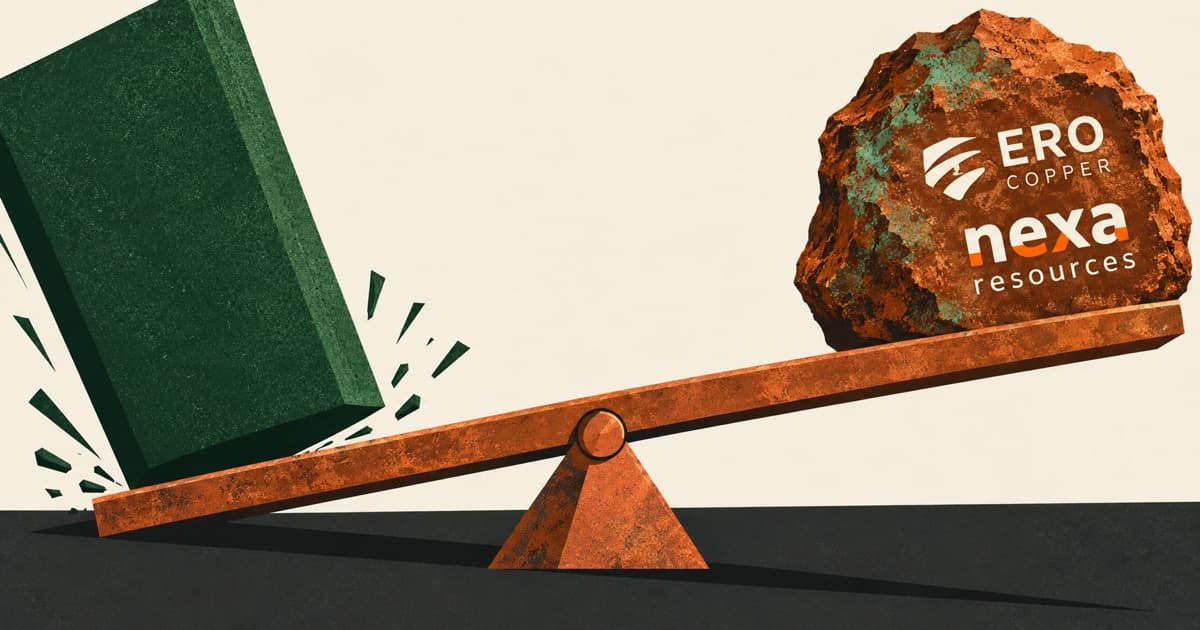
The real fell more than 11% to 5.58 per dollar after Lula won Brazil's runoff, which could cut dollar costs for Brazil-based miners Ero Copper and Nexa Resources.
On October 26, 2026, the Brazilian real fell more than 11% after Luiz Inacio Lula da Silva won Brazil's presidential runoff against Flavio Bolsonaro, a move that could lower US-dollar costs for Brazil-based miners such as Ero Copper (ERO) and Nexa Resources (NEXA) that sell their output in dollars.[1][2]
Lula received more than 64 million votes to Bolsonaro's just under 60 million, a margin of nearly 4 percentage points.[1] On voting day, October 25, the Polymarket contract on a Lula victory traded at about 0.2, implying roughly a 20% chance of a win.[3]
When trading resumed on October 26, the real dropped to 5.58 per US dollar.[2] More than half of the constituents on Sao Paulo's B3 exchange fell at least 10%.[4] The Ibovespa index hit a 10% decline, triggering a 30-minute circuit-breaker halt.[5] The US-listed iShares MSCI Brazil ETF (EWZ) fell 19.8% on the day.[6]
Why a weaker real changes company costs
An 11% drop in the real means an expense paid in reais costs about 9.9% less in dollars. The effect on a company depends on which currency it earns and which it spends.
Banks, payment companies and brewers earn reais inside Brazil; reported in dollars, their revenue shrinks. Miners and manufacturers in Brazil sell globally at dollar prices but pay wages, power and local services in reais, so a weaker real leaves their dollar revenue intact while their dollar costs fall.
Copper miners measure cost with "C1 cash cost," the direct cash spent per pound of copper.
From real devaluation to miners' dollar costs
Step one: labor, power and service costs paid in reais fall by about 9.9% in dollar terms.
Step two: for miners producing in Brazil and selling in dollars, the dollar cost per unit falls while dollar revenue is unchanged, so margins may widen.
Step three: a non-cash effect. Dollar and intercompany loans held by Brazilian subsidiaries are remeasured at the new rate, creating foreign-exchange gains or losses with no cash impact.
Companies that earn reais locally see dollar-reported revenue and earnings drop about 10% from translation, and a higher Selic benchmark rate would raise their funding and credit costs.
On October 26, Itau Unibanco (ITUB) fell 20.4%, Nu Holdings (NU) fell 17.0%, StoneCo (STNE) fell 27.4%, Inter (INTR) fell 34.9% and Ambev (ABEV) fell 14.2%. Export-oriented pulp producer Suzano (SUZ) rose 2.1%, and Vale (VALE) fell 3.2%.[6]
Companies that could be affected
Ero Copper (ERO)
Ero Copper runs the Caraiba, Tucuma and Xavantina operations in Brazil. All of its revenue, about $1.05 billion over the past four quarters, comes from copper and gold sold there at dollar prices.[7] It sits at the "spend in Brazil, earn in dollars" link.
In March the company guided 2026 copper C1 cash cost to $2.30 to $2.50 per pound at Caraiba and $1.95 to $2.15 per pound at Tucuma, attributing part of the increase to a stronger real.[8] On its May earnings call, the company also said the real had pushed up C1 costs, with foreign-exchange hedge gains offsetting some of the impact.[9]
Using guidance midpoints, the two mines' annual C1 costs come to about $356 million. Assuming roughly two-thirds is paid in reais (the company does not disclose this share), this devaluation could save about $23 million a year, or about 6% of the $378 million in operating income over the past four quarters, before any losses on foreign-exchange hedges.[7][8]
Separately, Ero disclosed that, as of June 30, each 10% weakening of the real would raise pre-tax income by $62.4 million, mainly a non-cash gain on intercompany loans.[10]
Ero's unit costs could fall, depending on the real staying weak and on its hedge losses; copper prices matter more to the company. ERO rose 4.2% on October 26 and has a market value of about $3.3 billion.[6][7]
Nexa Resources (NEXA)
Nexa Resources owns mines in Brazil including Vazante and Aripuana, plus the Tres Marias and Juiz de Fora smelters, and produces zinc, copper and lead priced in dollars.[7]
Its annual report states that each 10% move in the dollar against the real changes Adjusted EBITDA (earnings before interest, taxes, depreciation and amortization) by about $60 million, on a 2024 basis.[11] Scaled to 11%, that is about $66 million, close to 10% of the $680 million in operating income over the past four quarters.[7][11]
In the first quarter of 2026, the company attributed an unfavorable impact of about $8 million at its Brazilian operations to the real's appreciation.[12] On its August earnings call, it said the real's appreciation had raised the dollar cost of its Brazilian operations.[13] If the real stays weak, that drag could turn into a tailwind. Part of the gain would be offset by foreign-exchange losses on dollar debt in Brazilian subsidiaries, booked below EBITDA.
On August 27, controlling shareholder Votorantim agreed to sell its stake to Sweden's Boliden at 0.250 Boliden shares per Nexa share, covering only Votorantim's holding.[14] NEXA rose 1.4% on October 26 and has a market value of about $1.5 billion.[6][7] Nexa could benefit, depending on zinc prices and its upcoming quarterly reports.
What to watch next
Third-quarter reports in early November cover only the last week of October. The full effect should show in fourth-quarter results and 2027 guidance: Ero around January 2027, Nexa around February 2027.
Three things to track:
- Whether the dollar-real rate averages above 5.4 through the fourth quarter; the December 31 closing rate sets the fourth-quarter remeasurement.
- Whether Ero's third-quarter management discussion and 2027 guidance cite the weaker real as a cost tailwind, and how much its foreign-exchange collars actually lost.
- Whether the Brazil FX line in Nexa's third- and fourth-quarter EBITDA bridges flips from drag to positive.
What would break this chain:
- The real recovers to 5.0 to 5.1 within weeks, for example on a reassuring finance-minister pick or central-bank intervention.
- Ero's hedge losses absorb most of the cost savings.
- Brazilian wages and service prices catch up within two to three quarters.
- Copper or zinc prices fall by more than about 5%, swamping the currency effect.
- The new government raises mining royalties, export levies or energy prices.
This piece only helps surface transmission chains that may be overlooked. It is not a stock recommendation.
Sources
[1] Wandsworth Guardian · 2026-10-26 · Lula wins Brazil's presidential election · https://www.wandsworthguardian.co.uk/news/national/26672024.lula-secures-brazil-election-win-faces-hurdle-bolsonaro-contests-results/ [2] Sina Finance 7x24 · 2026-10-26 · Real falls more than 11% as trading resumes · https://finance.sina.cn/7x24/2026-10-26/detail-iniwqhxm9218570.d.html [3] Polymarket daily data · 2026-10-25 · Contract price on Lula winning the 2026 Brazilian presidential election [4] Bloomberg · 2026-10-26 · One-day wipeout for Brazilian stocks · https://www.bloomberg.com/news/articles/2026-10-26/one-day-wipeout-tops-60-for-the-hardest-hit-brazilian-stocks [5] News report · 2026-10-26 · B3 halts trading for 30 minutes after a 10% Ibovespa decline [6] Drillr price data · 2026-10-26 · Closing prices and daily moves [7] Drillr company data · 2026-10-26 · Segment, geographic and quarterly financials, market value [8] Ero Copper · 2026-03-05 · 2025 annual management's discussion and analysis (6-K) [9] Drillr earnings-call summary · 2026-05-05 · Ero Copper Q1 2026 earnings call [10] Ero Copper · 2026-08-05 · Q2 2026 management's discussion and analysis (6-K), foreign-exchange risk [11] Nexa Resources · 2025-03-27 · FY2024 Form 20-F, foreign-exchange risk [12] Nexa Resources · 2026-05-07 · Q1 2026 earnings release (6-K) [13] Drillr earnings-call summary · 2026-08-06 · Nexa Resources Q2 2026 earnings call [14] Drillr deal-event data · 2026-08-27 · Votorantim sale of Nexa control stake to Boliden