
Insurance Distribution Puts AI Agents Behind Controlled APIs
Summary
LendingTree says up to three quarters of its 700-plus partners quote only through backend APIs, showing why insurance AI agents still need controlled access.
From November 3 to 5, 2026, LendingTree (TREE), Allstate (ALL), Lemonade (LMND), NerdWallet (NRDS), and Trupanion (TRUP) said in third-quarter earnings-call materials that personal AI agents are entering insurance discovery and transaction handoffs. Live quotes, eligibility checks, compliance, and binding still depend on controlled company systems.[1][2][3][4][5]
Insurance agents can find products but cannot bind alone
The critical data in insurance shopping does not all sit on public websites. A consumer compares coverage and price, then the carrier checks location, risk, and eligibility, produces an executable quote, completes compliance documents, and binds the policy. A general-purpose AI agent can search and submit information, but without live rates, eligibility rules, and a binding interface, it can produce leads rather than policies.
The emerging distribution path therefore needs two capabilities. Platforms such as LendingTree and NerdWallet hold private product inventory and backend connections that can route one request to several carriers. Carriers such as Allstate and Lemonade control quoting and execution systems that can work with an outside agent after identity and permission checks. The consumer entry point may move away from a conventional search page, while the transaction remains with the company that can deliver a compliant quote and complete binding.
Private inventory and automated execution set the limit
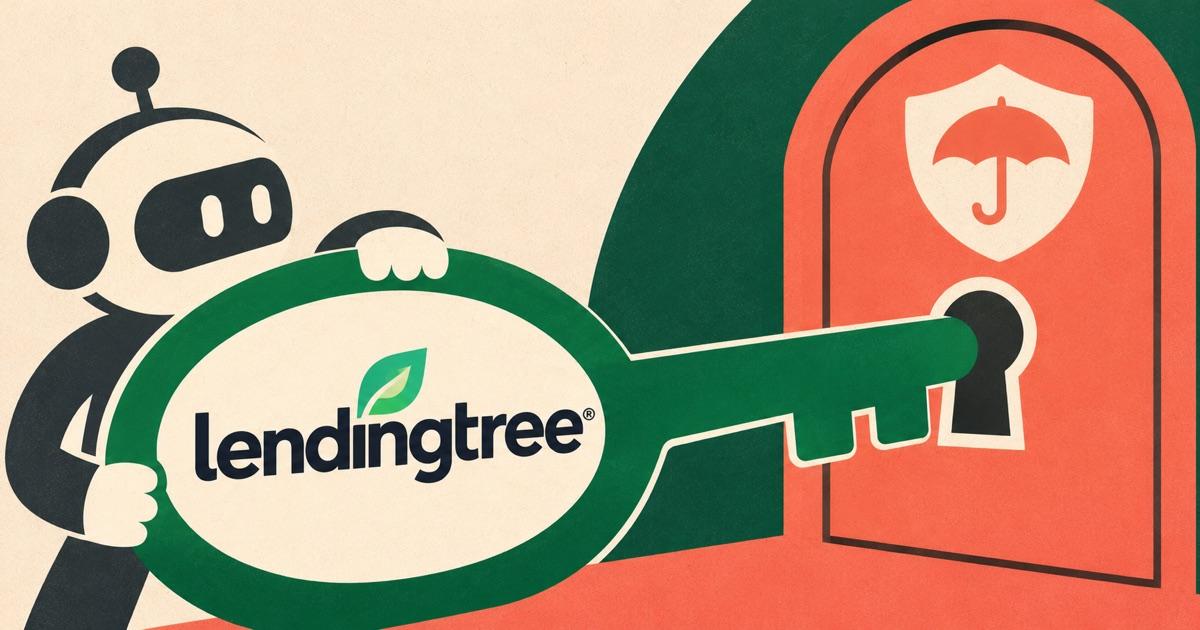
LendingTree's disclosure shows why public scraping cannot cover most comparable inventory. The company said its network includes more than 700 carriers and lenders, with roughly one half to three quarters quoting only through backend APIs rather than public online forms.[1]
"We have 700 plus carriers and lenders in our network. Roughly half to three quarters of these only quote via backend API access, not open online quoting."[1]
A personal agent that visits only public pages may therefore miss much of the inventory needed for a useful, executable comparison.
Carriers are also building their own machine-facing entry points. Allstate said it plans to launch a protection-focused personal AI agent in early 2027 and let it compare quotes from several carriers, including competitors.[2] Lemonade said its automated infrastructure can let its agents interact with customers' personal agents while handling strict documentation requirements.[3] NerdWallet pointed to deep inventory, dynamic pricing, eligibility checks, and compliance as reasons its marketplace still matters.[4] Trupanion said agents can explain non-price features such as transparency and direct veterinarian payment more clearly than conventional search.[5]
Distribution value is moving toward controlled connections
Personal agents may reorder customer acquisition, but they have not produced measurable large-scale traffic. EverQuote said less than 1% of its traffic comes from large language models and even less from agentic shoppers.[6] MediaAlpha said it had not yet seen any impact from personal AI agents shopping for consumers.[7] Both expect carriers to retain control over rate access, quoting, and binding, but they differ on third-party access: EverQuote is building a controlled connection, while MediaAlpha doubts carriers will show rates directly through third-party agents.
The useful follow-up test is whether agents create qualified requests and completed transactions, not whether they can generate insurance advice. Relevant measures include agent-sourced traffic and conversion, the number of connected carriers, controlled-API quote coverage, and whether carriers allow third-party agents to call rates in authenticated or authorized settings. Until those measures grow or become visible, a change in discovery cannot be treated as marketplace revenue growth or proof that established distribution has been replaced.
Companies exposed to the same mechanism
- EverQuote (EVER): Its property-and-casualty marketplace is building a controlled connection for AI platforms to access carrier products, leaving it exposed to carrier participation and interface access, although current agent traffic does not establish a financial benefit.
- MediaAlpha (MAX): Its insurance marketplace also depends on carrier inventory and conversion rules. If quoting and binding remain inside carrier-controlled environments, its position depends on maintaining a controlled traffic connection.
Sources
[1] Drillr · LendingTree · November 3, 2026 · Q3 2026 earnings call
"We have 700 plus carriers and lenders in our network. Roughly half to three quarters of these only quote via backend API access, not open online quoting."
[2] Drillr · Allstate · November 5, 2026 · Q3 2026 earnings-call summary and Q&A
[3] Drillr · Lemonade · November 5, 2026 · Q3 2026 earnings-call summary and Q&A
[4] Drillr · NerdWallet · November 5, 2026 · Q3 2026 earnings-call summary and Q&A
[5] Drillr · Trupanion · November 5, 2026 · Q3 2026 earnings-call summary and Q&A
[6] Drillr · EverQuote · November 2, 2026 · Q3 2026 earnings call
[7] Drillr · MediaAlpha · October 28, 2026 · Q3 2026 earnings call
This material is for identifying potentially overlooked industry changes and companies only. It is not a stock recommendation.