
UK Land Development Loses Capital as Returns Fall Below Hurdles
Summary
Barratt Redrow approved just over 3,000 plots against a 10,000-12,000 target and Kier halted new property development as UK returns fall below hurdles.
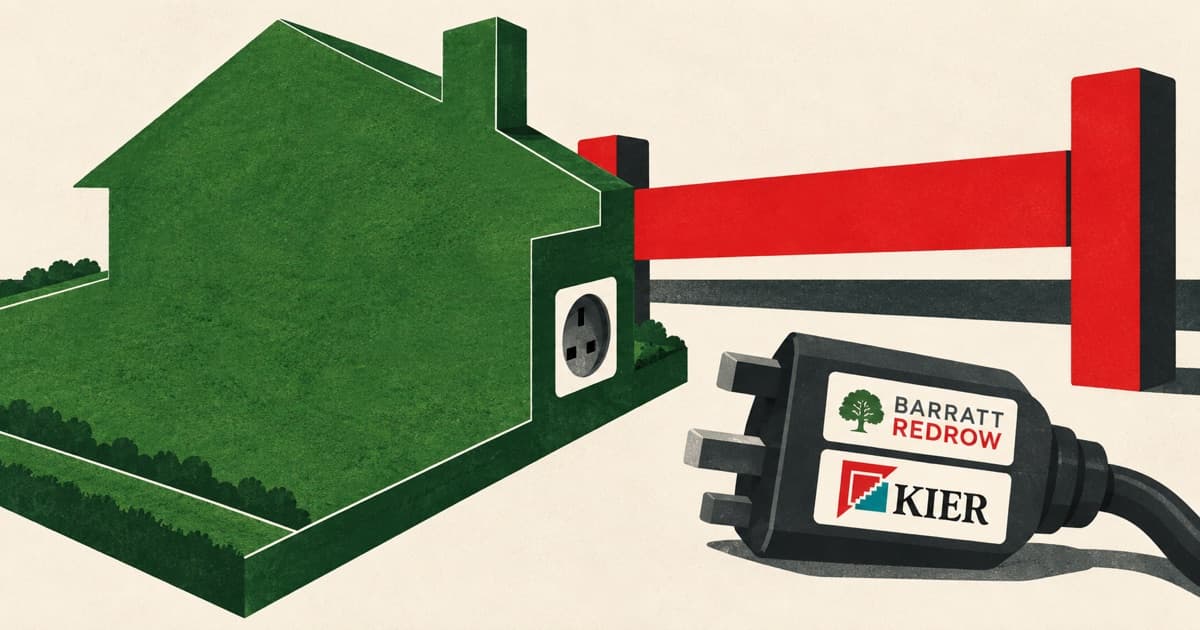
Barratt Redrow plc (BTDPY) and Kier Group plc (KIERF) told investors on their fiscal 2026 results calls on September 15 and 16, 2026, that UK development capital is being pulled back because returns on new sites no longer clear their own hurdles. Both companies hold projects that already have or are close to planning permission, and both are cutting new land and development investment and recycling the capital [1][2].
Planning permission is in hand, but the return test fails
A UK housebuilder buys land, secures planning permission, then builds and sells homes, and a single site can take several years to sell out. Builders therefore hold a land bank, measured as the number of years of building the land they own or control would support at the current pace. Before buying a new site, they estimate its return on capital employed (ROCE, operating profit divided by the capital tied up) and walk away if it falls below an internal hurdle.
Slow planning approval has often been seen as the main brake on new UK housing supply. The two calls describe a different constraint. Kier has planning secured on around 80% of its property projects, including around 5,000 residential units [1]. Barratt Redrow management said that all housebuilders and land traders have a lot of land in planning [2]. What is failing is the return: Barratt Redrow estimates underlying selling prices fell by just under 1% for the year [2], and weaker prices push down the projected return on a new site.
A builder that already controls enough consented land can simply run that land down instead of replacing it. UK peers face the same house prices and build costs, so the same choice could spread across the industry.
Land and development spending far below earlier plans
Barratt Redrow's pullback is the largest. In February 2026 it set a fiscal 2026 target of 10,000 to 12,000 plots approved for purchase [3]. It approved just over 3,000, a figure that is net of nearly 5,000 cancelled plots [2]. Its land bank fell to 5.2 years, gross land investment fell by GBP 464 million, fiscal 2026 ROCE was 9.2%, and it plans to return GBP 400 million to shareholders in fiscal 2027. Management said the next two years are primarily about using the land it already owns or controls [2].
Kier reversed course within six months. In March 2026 it planned to deploy up to GBP 225 million into its property business, targeting a long-term ROCE of 15% [4]. At its full-year results in September, the property division reported ROCE of 4.3%, and the company said it will not invest in any new property developments. Existing programs will be completed, capital employed in property is expected to peak in December 2026, and roughly the first GBP 150 million is expected to be released over the next three years to strengthen the balance sheet [1].
One company is a housebuilder and the other a contractor, yet in the same week they made the same capital decision: no new money for development that already has consent, with released capital going to shareholders or the balance sheet.
Land sellers feel it first; building materials later
When developers buy less land, sellers of land are the first to feel it. Barratt Redrow said there are fewer bidders and that prices for land coming to market are broadly flat. Management also said land prices typically fall with a lag of about 18 months and that a lot of land will come to the market in 2027 and 2028 [2]. On that view, losses for landowners and strategic land promoters would show up over the following one to two years.
The conclusion has clear limits. Persimmon's owned and controlled land bank fell by 4,000 units in the first half, but it is still buying land and said planning on the ground is still slow [5]. Kier's exit also reflects a wish to cut volatile, transaction-led earnings and focus on its core infrastructure and construction businesses, and its property division had revenue of only GBP 63 million within group revenue of about GBP 4.4 billion [1]. Barratt Redrow guides fiscal 2027 approvals back up to 6,000 to 8,000 plots, but only if it sees sufficiently attractive opportunities [2], so this could be a cyclical pause while land prices reset.
Two indicators to watch are Barratt Redrow's actual fiscal 2027 land approvals and whether other UK builders move from replacement-only land buying to net land reduction.
Companies exposed to this shift
- Taylor Wimpey (TWODY): A large UK housebuilder facing the same house prices and build costs as Barratt Redrow. On its first-half 2026 call it said existing land and smaller sites will support outlet growth without new net land investment [6]; its next disclosures will show whether its land position keeps shrinking.
- Bellway (BLWYY): A UK housebuilder that described a largely replacement-only land strategy with GBP 500 million to 600 million of land spend in March 2026 [7]. Its full-year results around October 2026 will test whether it moves to net land reduction.
- Ibstock (IBJHF): A UK clay brick maker selling mainly into new-build housing, where housing starts are its key indicator. Its domestic brick deliveries were already down about 8% year on year in the first five months of 2026 [8]; fewer land purchases would further reduce starts once existing land banks are used up.
Sources
[1] Drillr · Kier Group plc (KIERF) · 2026-09-15 · Fiscal 2026 results call
From this point, we will not invest in any new property developments.
[2] Drillr · Barratt Redrow plc (BTDPY) · 2026-09-16 · Fiscal 2026 results call
[3] Drillr · Barratt Redrow plc (BTDPY) · 2026-02-11 · Fiscal 2026 interim results presentation
[4] Drillr · Kier Group plc (KIERF) · 2026-03-03 · Fiscal 2026 half-year results call
[5] Drillr · Persimmon plc (PSMMY) · 2026-08-06 · First-half 2026 results call
[6] Drillr · Taylor Wimpey (TWODY) · 2026-07-31 · First-half 2026 results call
[7] Drillr · Bellway (BLWYY) · 2026-03-24 · Fiscal 2026 half-year results call
[8] Drillr · Ibstock plc (IBJHF) · 2026-08-05 · 2026 half-year results call
This article highlights industry changes and companies that may be overlooked. It is not a stock recommendation.