
Canadian Drone Procurement Begins With First Orders
Summary
Volatus (TAKOF) and Draganfly (DPRO) say Canada's Canadian-only drone marketplace awarded first orders within days: 100-unit lots with options up to 5,000.
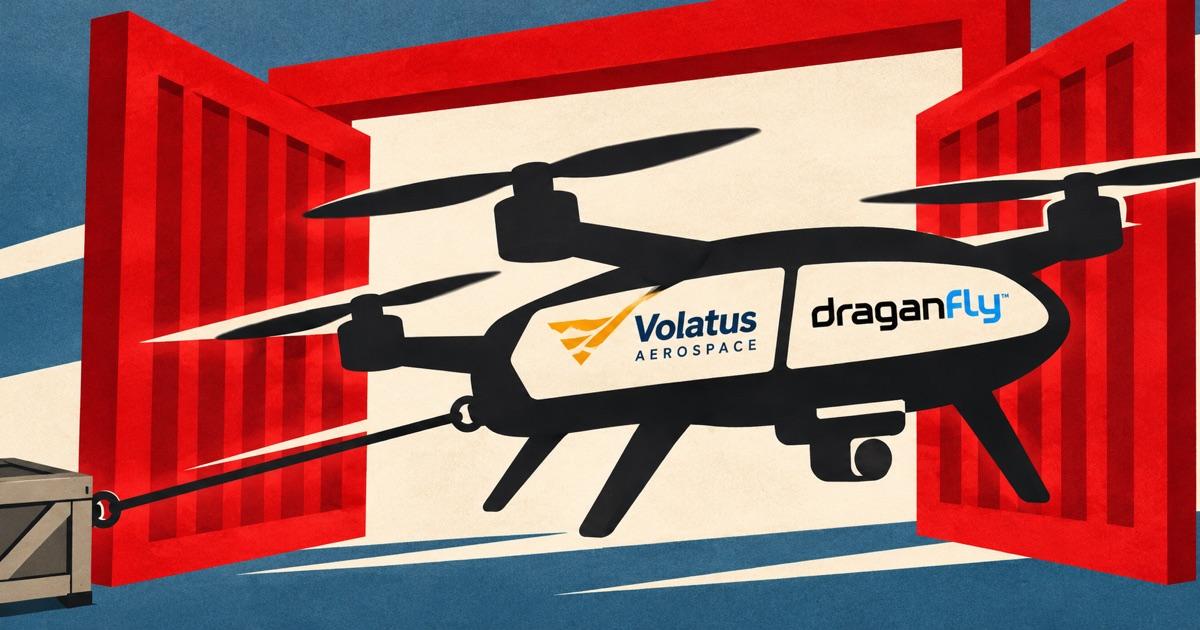
Canada's military drone procurement has shifted to a fast, Canadian-only marketplace, according to Volatus Aerospace (TAKOF) and Draganfly (DPRO). On their separate third-quarter 2026 earnings calls on November 10, 2026, both companies said Canada's Department of National Defence placed first military orders with them soon after they passed supplier qualification on a procurement platform open only to Canadian companies [1][2].
How Canada's Defence Drone Initiative marketplace works
Canada's Defence Drone Initiative (DDI) replaced project-by-project military drone tenders with a standing list of pre-qualified suppliers. Companies apply for qualification and are sorted into five streams: aircraft, counter-drone systems, communication software, systems integration, and testing and innovation. The military then issues short-window requests for proposals, and only Canadian companies can bid [1][2]. The government said on September 10 that about 400 suppliers had pre-qualified, and that initial contracts worth up to C$50 million went to six companies: Volatus, Draganfly, Beonyx, AVSS, Twenty20 Insight and Objexis AI [3].
The contract design lets the military test a small batch before committing to volume. Volatus management said first DDI contracts usually open with a 100-unit order and can grow to as many as 5,000 units, and the government can exit if a supplier's technology falls short or the supplier cannot scale [1]. Draganfly described the same sequence: it delivers the first 100 drones, the military trains on and tests them, and follow-on orders depend on demand [2]. This structure lowers the military's risk of backing the wrong supplier and gives very small companies a path to a first order, so the shift is unlikely to stay limited to one or two companies.
Both companies won first orders far faster than a traditional defence cycle
Volatus qualified in all five streams in September and won its first Canadian Armed Forces contract within days. It plans to deliver the first 100 systems in late November or early December, well ahead of the September 2027 schedule in the contract [1]. The company said its total order backlog crossed C$100 million for the first time, although its finance chief said only about a quarter of that backlog is defence business [1]. Draganfly's Department of National Defence award is worth C$25 million in total for up to 5,000 drones. Draganfly said it is involved in 19 Canadian military RFPs and expects to announce at least two more contracts before year-end [2].
Two independent companies describe the same process and pace, which supports the view that Canada's military buying method has changed. The orders have not yet turned into revenue. Draganfly's third-quarter revenue was C$2.05 million, down 5% year over year, and management pushed its expected inflection point to the second or third quarter of 2027 [2]. Volatus's first deliveries do not start until year-end [1].
Orders go to Canadian firms, but production and parts still rely on foreign partners
Budget and industrial policy set how far this channel can go. Citing Canada's Budget 2026, Volatus said the DDI is slated to receive C$2.3 billion over five years, and that the government has set a goal of shifting 70% of defence procurement to domestic sources by the end of 2035 [1]. With the order entry point already restricted to Canadian companies, later factories, motors and electronics may also face pressure to move onshore over time.
The near-term bottleneck is production. Volatus management said there is virtually no mature drone technology produced at scale in Canada, so the first tranche is built by partners and parts kits may initially come from foreign markets [1]. As an example, management said building 10,000 small drones a month would take 40,000 electric motors and about 2 million rare earth magnets [1]. That means part of the value of early orders may flow to foreign partners, which could pressure Canadian suppliers' margins.
Competition is also heavy. Volatus said about 62% of the 397 suppliers that qualified in the first tranche report 25 employees or fewer, it estimates roughly 50 of them are direct competitors, and further tranches are still being reviewed [1]. The next things to track are whether higher-volume follow-on orders arrive after the 100-unit opening lots, and when the two companies recognize these contracts as revenue.
Which other companies are exposed to Canada's drone marketplace
- ZenaTech (ZENA): ZenaTech was selected as a qualified DDI supplier on September 17, so it faces the same Canadian-only bidding and the same 100-unit opening, up-to-5,000-unit contract structure, but it has not yet won an order [4]. Most of its revenue comes from drone survey services, with estimated third-quarter revenue of C$13.4 million to C$14.8 million, so its defence drone business is small [5].
- AIRO Group (AIRO): AIRO's subsidiary Jaunt Air Mobility Canada received a DDI supply arrangement on October 15, which can bring its RQ-35 reconnaissance drone into the same procurement channel [6]. The company's roughly $163 million drone backlog is entirely international and does not yet include Canadian orders [7].
Sources
[1] Drillr · Volatus Aerospace (TAKOF) · 2026-11-10 · Q3 2026 earnings call
"Our objective, as you know, I think most people that are Volatus investors know, that the initial contracts that come out of DDI have that 5,000-unit possibility with oftentimes 100-unit opening order. It gives the government an off-ramp for companies that are developing technologies that maybe don't meet the requirements or they can't scale."
[2] Drillr · Draganfly (DPRO) · 2026-11-10 · Q3 2026 earnings call
[3] Leader-Post (PR Newswire) · Government of Canada release · 2026-09-10 · Government announcement · https://leaderpost.com/press-releases/pr-newswire/canada-and-ukraine-to-scale-up-drone-production-build-up-canadas-defence-industries-and-achieve-a-just-and-lasting-peace-in-ukraine/
[4] GlobeNewswire · ZenaTech · 2026-09-17 · Company release · https://www.globenewswire.com/news-release/2026/09/17/3363922/0/en/zenatech-selected-for-canada-s-defence-drone-initiative-marketplace-expanding-opportunities-for-zenadrone-s-ai-powered-autonomous-drone-solutions.html
[5] GlobeNewswire · ZenaTech · 2026-10-13 · Company release · https://www.globenewswire.com/news-release/2026/10/13/3379560/0/en/zenatech-reports-over-27-organic-growth-across-existing-drone-as
[6] Business Wire · AIRO Group · 2026-10-15 · Company release · https://www.businesswire.com/news/home/20261015779481/en/AIRO-Qualifies-for-Canadas-Defence-Drone-Initiative-Marketplace/
[7] Drillr · AIRO Group (AIRO) · 2026-08-13 · Q2 2026 earnings call
This analysis highlights industry changes and companies that may be overlooked. It is not a stock recommendation.